Klik hier voor de NL-versie.
Click here for the EN version.
Les sources ici – bronnen hier – references here
Le 26 Mars 2026, le NSV (Nationalistische Studentenvereniging – Association des étudiants nationalistes), appelle une fois encore à marcher dans une ville flamande, cette année à Louvain. Cette marche vise à mettre en avant le terme raciste « remigration », un concept faisant référence aux déportations de masse qu’ils veulent normaliser. Chaque année, la plus grande association étudiante flamande d’obédience fasciste organise cette marche, en alternant entre les trois villes majeurs du nord de la belgique: Anvers, Gand et Louvain. Cette marche rassemble une coalition de militants fascistes, racistes et nationalistes de Flandre, de Wallonie et d’Europe. Au fil du temps, cet évènement, presque annuel, est devenu un moment de rendez-vous incontournable du fascisme flamand et au delà.
Les plus de quarantes années d’existence de ces marches sont cependant aussi une histoire de résistance. Depuis ses premiers jours, la tentative du NSV de prendre lors rues lors de cet évènement a à chaque fois rencontré tout type d’opposition imaginable: des lancers d’œufs pourris aux tentatives de recouvrir leurs discours sous la musique, jusqu’ aux barricades en feu et aux émeutes jusqu’au bout de la nuit. Cette résistance constante au fil des années provient notamment du fait que cette marche n’est pas, et n’a jamais été, une simple manifestation étudiante. Le NSV, malgré ses tentatives récentes de dédiabolisation, a toujours continué à publier des contenus racistes, à attaquer des personnes racisées, et à donner une plateforme au sein des universités aux acteurs majeurs du fascisme flamand et international, du Vlaams Belang au Ku Klux Klan.
Depuis sa fondation en 1976 à Anvers, comme une scission extrémiste du KVHV (une organisation étudiante de droite catholique), le NSV a toujours été un carrefour dans l’écosytème de l’extrême droite flamande. Pendant des décennies, il a fonctionné comme un centre de formation idéologique et comme une pipeline de recrutement pour le Vlaams Block and son successeur, le Vlaams Belang, nombre de ses leaders nationaux étant passé dans ses rangs. L’organisation hébege régulièrement des figures belges et internationales d’extrême droite, de Dries Van Langenhove à Martin Sellner, tout en maintenant des liens avec des groupuscules plus marginaux comme le Voorpost ou Schild & Vrienden. Reflétant cette position entre la politique parlementaire et le fascisme de rue, la marche annuelle du NSV rassemble des politiciens du Vlaams Belang, des intervenants internationaux ainsi que des groupes fascistes organisés venant de toute la Belgique et d’ailleurs. Il s’agit là d’une convergence de toutes les factions d’extrême droite dans les rues flamandes, un mariage explosif entre des discours d’acteurs institutionnels et la violence de rue des neo-nazis.
Bien sur, le NSV n’a jamais été capable d’organiser ces marches sans une féroce opposition. Années après années, des antifascistes, des organisations étudiantes et des mouvements de gauche au sens large, se sont mobilisés pour confronter l’extrême droite. Tracer l’histoire de la marche annuelle du NSH révèle une longue et vivante tradiction résistance antifasciste en Flandre, dirigée à la fois contre le fascisme lui même et contre la répression d’état qui protège la marche. Les contre-mobilisations ont rassemblées chaque courant de la gauche, des partis politiques aux groupes autonomes, déployant ainsi un large éventail de tactiques: blocages, mobilisations de masse, bruit, projectiles, émeutes. Les jeux ont rarement été équitables. La marche du NSV, sous haute protection de la police et d’un service d’ordre habitués aux violences de rue, alors que les contre-manifestant·es sont traditionnellement les premières cible d’une répression violente de la part des force de l’ordre. Cependant, malgré ce déséquilibre, les antifascistes n’ont jamais permis au NSV d’être maître dans les rues flamandes.
À chaque fois, les contre manifestant·es ont dépassé leur nombre, les ont humiliés et ont perturbé leurs tentatives de se présenter comme une force sûre d’elle. Certaines années, comme en 2000, 2015 et 2018, la pression exercée l’année précédente a même suffi à empêcher la tenue de cet évènement. L’histoire de la marche du NSV n’est donc pas seulement une histoire de mobilisation fasciste, mais aussi et surtout celle d’une résistance tenace et frontale. Pendant des décennies, les antifascistes en Flandre sont retournés dans la rue chaque année pour s’y opposer, et ont clairement montré que, peu importe le niveau de protection fourni par l’État, le NSV ne pourra jamais défiler en paix.
1980 – 1995: les débuts de la résistance
En 1976, le NSV est fondé à Anvers en tant que scission du KVHV. Deux ans plus tard, le NSV Gand voit le jour. L’organisation fasciste suscite immédiatement l’hostilité : avant même que le NSV ne commence à organiser ses propres défilés, des manifestations s’oppose déjà à lui. Le 5 février 1980, l’AFF (Front antifasciste) et la VVS (Association des étudiants flamands) organise par exemple une manifestation à laquelle ont participe 750 personnes. Les années 1980 sont marquées par les tensions dans la région des Fourons, par les tueurs du Brabant, les CCC et le mouvement punk. Le mouvement flamand est aussi en pleine effervescence. Parallèlement, les actions du NSV font la une des médias grand public. Jusqu’en 1982, la NSV est une association étudiante reconnue à l’université de Gand, ce qui lui permet d’organiser des événements sur le campus et d’obtenir le remboursement de certains frais, comme les tracts. Elle est toutefois exclue à la suite d’un affrontement violent avec des militants de gauche
En 1981, la section de Louvain du NSV est fondée. Le 2 février 1981, le NSV organise un rassemblement en faveur de l’apartheid à Gand, au Blandijn. En collaboration avec l’AFF, le VVS organise une manifestation interdite contre le racisme et l’apartheid. Lorsque les manifestants arrivent au Blandijn, des émeutes éclatent. La police réprime durement les manifestants, en particulier les antifascistes ; plusieurs sont arrêtés et l’un d’entre eux reste en détention pendant une longue période. Dans les jours qui suive la manifestation, une guerre de tracts éclate entre la gauche et la droite au sujet de la version des faits concernant les affrontements.
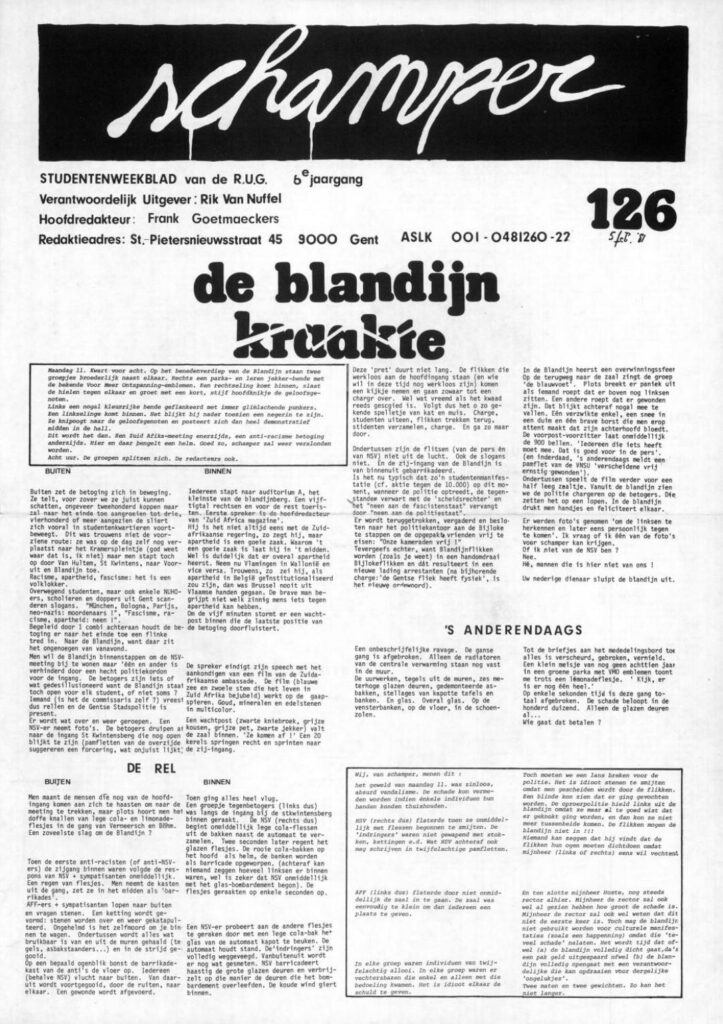
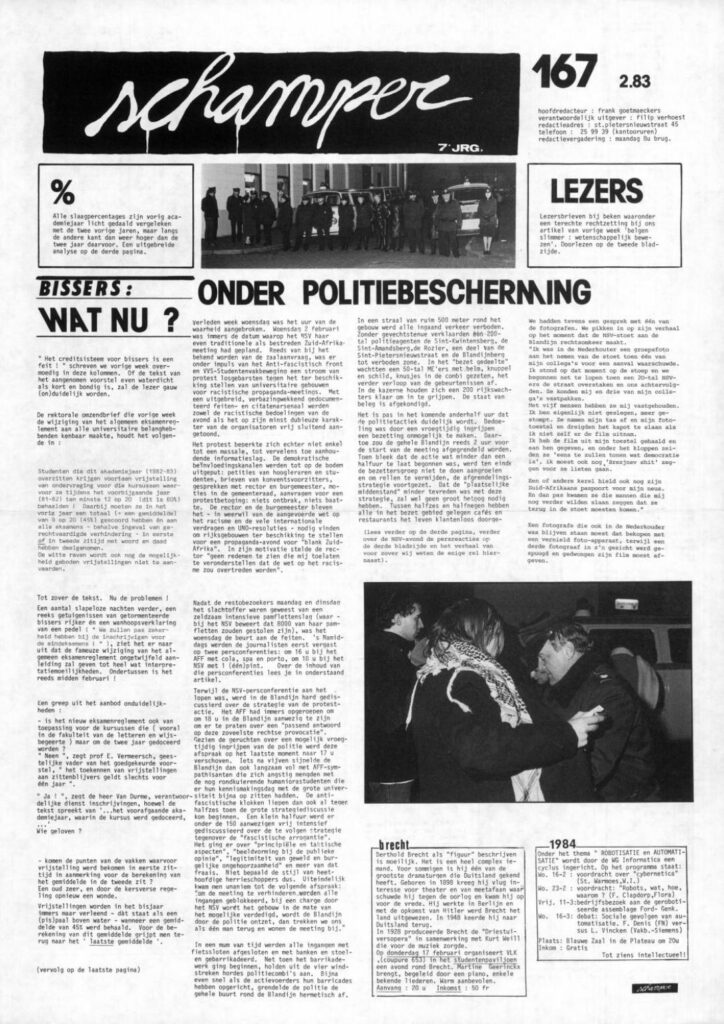
Le 2 février 1983, le NSV organise une nouvelle réunion sur l’Afrique du Sud au Blandijn, à Gand. Cette fois-ci, la résistance a recours à une autre tactique : des membres de l’AFF et de la VVS bloquent à l’avance les différentes entrées du bâtiment à l’aide de cadenas de vélo, obligeant ainsi les nationalistes à organiser leur réunion ailleurs.
En 1984, le NSV de Louvain apprend qu’il ne recevra aucune subvention du Conseil général des étudiants. Le 8 mars de cette année-là, l’organisation occupe le centre culturel Stuc, situé à l’époque sur le campus des sciences sociales. Des centaines d’étudiants se rassemblent pour une manifestation spontanée contre cette occupation, certains armés d’œufs. Pendant ce temps, 40 membres du NSV, armés de bâtons et de tuyaux, chargent la foule. Cette action est orchestrée par le président Jurgen Ceder (qui deviendra plus tard membre du Vlaams Blok et de la N-VA, ainsi que l’avocat à l’origine du controversé plan en 70 points), qui, selon un témoin du magazine étudiant Veto, « exprime régulièrement ses opinions à coups de poing américain et de chaîne de vélo ». Un étudiant est gravement blessé au tibia après avoir reçu un coup de pied de Ceder, qui a été identifié par plusieurs témoins ayant porté plainte. La victime garde une invalidité permanente et souffre de complications. Ceder est finalement acquitté faute de preuves.
Le 3 février 1984, Luc Onbekent, membre du NSV et du VMO, tente d’assassiner un Marocain dans un bar de Sint-Niklaas en lui donnant trois coups de couteau à la gorge. En 1984, une nouvelle attaque perpétrée par une unité commando du NSV contre un bar à Bruges, fait trois blessés ; auparavant, un incident violent impliquant le NSV s’était également produit dans un bar gay. Lorsque cette unité commando est arrêtée par la police, celle-ci a découvre une chaîne de vélo, des munitions, une liste d’adresses de contacts en Allemagne et des billets allemands. En 1985, deux militant·es du « Comité de boycott de l’apartheid » sont passés à tabac par le NSV.
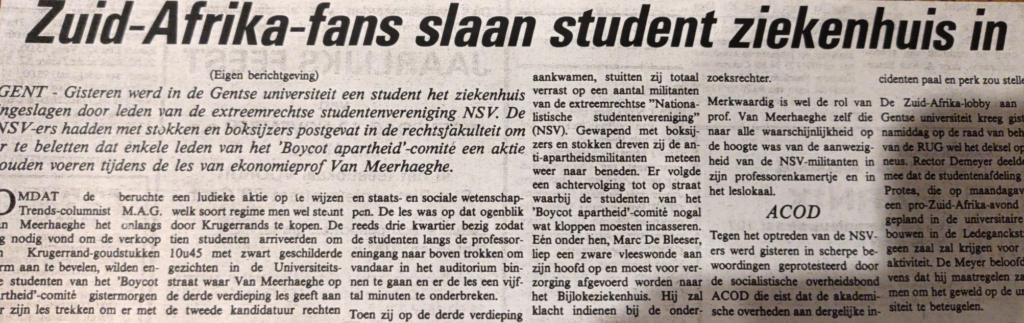
Le 5 décembre 1985, le NSV se rend à la Vrije Universiteit Brussel (VUB) avec un groupe de 45 personnes pour vendre son magazine et provoque des bagarres, en utilisant des matraques et des poings américains. Plus d’une centaine d’étudiant·es de la VUB résistent spontanément à cette agression. Le 27 février 1986, 300 membres du NSV manifestent à Gand sous le slogan « C’est mon peuple, ne vous en mêlez pas », lors de ce qui fut peut-être leur premier rassemblement autonome. Parmi les autres groupes présents figurent le VMO, le Nationaal Front, l’ODAL et Were Di. Le Vlaams Blok a également appelé à l’avance à se joindre à la manifestation. Une contre-manifestation est organisée par l’AFS (Coopération antifasciste), également avec 300 personnes, réclamant l’interdiction du NSV. Lorsque le cortège du NSV passe devant le siège des anarchistes, une petite bagarre éclate.
En juin 1989, une trentaine d’étudiant·es membres de la NSV célèbrent le centième anniversaire d’Adolf Hitler à Anvers ; le propriétaire du bar Het Kroegske, également ancien président de la NSV, porte pour l’occasion un t-shirt du Ku Klux Klan. En octobre 1990, les sections d’Anvers, de Bruxelles et de Louvain de la NSV se rendent à Gand, où elles distribuent des tracts au restaurant étudiant De Brug. À la suite de ce dernier incident du NSV, le Conseil politique et philosophique réaffirme l’interdiction des associations racistes et fascistes, telles que la NSV, à l’université de Gand.
Le 20 février 1992, le NSV organise un autre rassemblement à Louvain. Des organisations de gauche appelent à l’interdiction de ce rassemblement, et 1 000 lettres sont recueillies auprès d’habitants de Louvain s’opposant au rassemblement. Le NSV attire une foule de 500 personnes, dont des délégations venues des Pays-Bas et de France ; quatre contre-manifestations sont organisées. Cinquante parachutistes de la caserne de Tielen participent à la manifestation. Finalement, les différents contre-manifestants encerclent le parcours. Le NSV lance des pétards, tandis que les contre-manifestants répondent en jetant des sacs poubelles et des œufs. Les contre-manifestants traitent les membres du NSV de nazis, et l’un des manifestants leur répond qu’ils en est fier. À la fin de la manifestation, un petit groupe du NSV de Louvain est protégé par la police contre les actions des contre-manifestants. Dans l’ensemble, la soirée se déroule dans un climat relativement paisible. Le 22 février 1994, une bagarre éclate à la cafétéria de la VUB entre 25 membres du NSV et des étudiant·es de la VUB, après que les premiers eurent collé des affiches et peint des croix gammées sur le campus. Les étudiant·es du NSV lancent l’attaque en scandant le slogan « charge ».
Ces décennies, marquées par l’essor du NSV, ne sont que le début d’une longue lutte, qui ne fit que s’intensifier au cours des années suivantes. De plus, durant ces années, la réputation du NSV fut entachée par les polémiques et l’impopularité, ce qui entrava sa recherche de soutien institutionnel.
1996 – 2005: ‘Geen Fascisten in Onze Stad!’: la bataille s’intensifie dans les rues
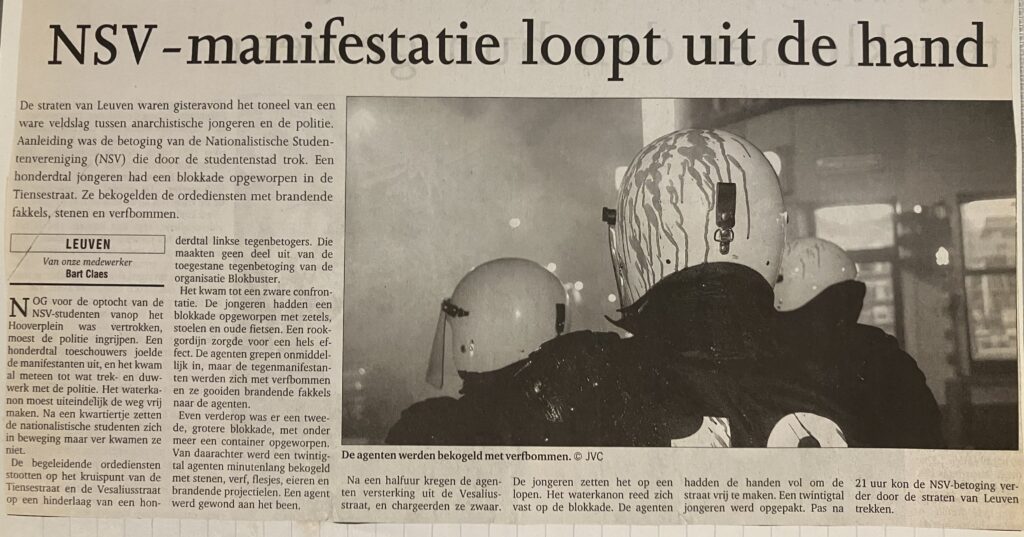
À l’approche de la fin de la décennie, les mobilisations du NSV commencent à s’essouffler, que ce soit en raison de l’opposition rencontrée ces dernières années ou simplement du déclin de l’attrait du fascisme. La résistance antifasciste à leurs défilés ne fait que s’intensifier, malgré une répression étatique croissante qui contribue à protéger les fascistes. En 1996, environ 700 fascistes du NSV défilent dans la ville de Louvain. Plusieurs centaines de contre-manifestant·es de « Leuven Fascisme Vrij » et « d’Aktiefront Stop Fascisme » descendent dans la rue malgré l’interdiction du bourgmestre, après avoir transformé la veille le restaurant étudiant Alma en un faux poste de contrôle militarisé afin de mettre en scène et de satiriser le monde souhaité par le NSV et le Vlaams Blok. De nombreux antifascistes sont placés en garde à vue après avoir été encerclés par plus de 200 policiers. En 1998, les effectifs du NSV tombent à environ 200 personnes à Gand, face à 500 contre-manifestants. Les antifascistes les affrontent avant même le début de la marche et se heurtent violemment aux cordons de police envoyés pour protéger les fascistes : 41 manifestant·es sont placés en garde à vue.
L’ampleur et la virulence des contre-manifestations atteignent leur paroxysme au tournant du siècle : en 1999, à Louvain, les quelque 200 partisan·es du NSV sont largement surpassés en nombre par environ 1 500 à 2 000 contre-manifestant·es, lors de deux manifestations distinctes organisées par le PVDA et le Collectief tegen Fascisme, que l’État avait toutes deux tenté d’interdire. Une première confrontation éclate lorsque les contre-manifestant·es se déplacent de la Blijde Inkomsstraat vers la Tiensestraat, en scandant : « Wij mogen niet betogen van Tobback, de extreem-rechtsen wel » (« Tobback ne nous laisse pas manifester, mais l’extrême droite, oui »). Des pierres sont lancées et des coups échangés à la Maria Theresiastraat et à la Bogaardenstraat, et 170 arrestations suivent. Certain·es antifascistes particulièrement robustes nécessitent l’intervention de six policiers chacun·e pour être évacués ; l’un·e d’entre est armé et prêt à passer à l’action avec une batte de baseball. Au fur et à mesure que la nuit avance, les antifascistes allument des feux, lancent des pierres et des ampoules remplies de peinture rouge, et tirent des feux d’artifice. Une voiture de police dans la Blijde Inkomststraat a ses vitres brisées.
Au cours des années suivantes, le NSV a du mal à regagner les effectifs déjà en baisse. Aucune information existe concernant un défilé en 2000, ce qui laisse supposer qu’après la cuisante défaite de l’année précédente, le mouvement a tout simplement perdu le courage de l’organiser. En 2001, cependant, ils reviennent à Anvers. Cette année-là, tout en étant couverts par une musique reggae incroyablement bruyante diffusée depuis une résidence étudiante sur l’Ossenmarkt, le slogan classique « Geen fascisten in onze stad ! » est scandé par des contre-manifestant·es étudiant·es venus des trois grandes villes flamandes ainsi que de Bruxelles, avec un soutien notable des étudiants francophones de l’ULB.
En 2002 à Gand, la distance habituelle entre les militants de gauche alignés sur les syndicats et les partis, et l’aile plus autonome de l’antifascisme se manifeste dans les rues. Le « Comité United Colours », une plateforme d’étudiant·es antiracistes soutenue par l’ABVV et l’ACV, appele à une manifestation pacifique de la Sint-Annaplein à l’Oude Beestenmarkt. Plus tard dans la soirée, la campagne antifasciste Blokbuster appelé à une contre-manifestation distincte, mobilisant environ 800 personnes pour dépasser en nombre la marche du NSV, qui compte 200 participant·es. Certains manifestant·es autonomes se détachent du cortège et tentent d’affronter directement le NSV. La police anti-émeute bloqué ces tentatives d’atteindre les fascistes près de Kantienberg, où des pierres et des bouteilles sont lancées sur les lignes de police. Les forces de l’ordre lancent l’offensive avec un bataillon de 250 agents, appuyés par un hélicoptère et deux canons à eau. Une quarantaine de gardes à vue suivent, mais de nombreux·ses antifascistes parviennent à s’échapper par les ruelles de la ville. Sept vitrines de la Vlaanderenstraat n’ont pas survécu à la soirée.
En 2003, de retour à Louvain, le NSV ne réussi à rassembler que 250 manifestant·es, une fois de plus surpassés en nombre par environ 700 contre-manifestant·es. Dans la période qui a précédé l’événement, le porte-parole de Blokbuster, Sven De Deken, a publiquement pris ses distances par rapport aux lanceurs de pierres des années précédentes, soulignant que l’aile la plus belliqueuse se mobiliserait séparément. Quelle que soit la réalité de cette scission, la présence d’une force de confrontation plus concentrée, composée d’anarchistes et de squatteur·euses, s’avère efficace. Deux barricades de canapés, de chaises et de vieux vélos est érigées à la Tiensestraat et à la Vesaliusstraat, d’où la police est bombardée de pierres, de peinture, d’œufs, de fusées de détresse et, selon certaines sources, même de cocktails Molotov, laissant un agent boiter, blessé à la jambe, et plusieurs voitures de police endommagées. Le NSV passe une grande partie de la soirée à se faire hurler dessus, coincé pendant plus d’une heure derrière les barricades. Sa marche peine à démarrer, bloquée pendant des heures tandis que la police tente de dégager le passage, son canon à eau se coinçant dans les barricades. Le NSV reprend sa marche bien après 21 h, après une longue attente pour que la police lui ouvre la voie. 21 contre-manifestant·es sont arrêtés. La même année, luttant pour retrouver leur dignité, le NSV tente de déployer une banderole à Zaventem. Aucune contre-mobilisation n’a été nécessaire, car ils ont été vaincus par leur propre banderole, trop difficile à déployer pour eux. Plus tard dans l’année, ils font de nouveau l’objet d’un tollé médiatique pour avoir organisé un concert d’un groupe néonazi néerlandais à l’occasion de l’anniversaire de la Nuit de cristal.
En 2004, entre 100 et 250 membres du NSV se rassemblent à Anvers, face à 400 à 600 contre-manifestant·es. Les affrontements sont moins vifs cette année-là, même si quelques heurts ont lieu près de la gare de Berchem. Une semaine auparavant, des étudiant·es de gauche avaient protesté contre l’utilisation par le NSV d’une salle à la KULeuven, scandant le slogan intemporel « Geen fascisten in onze stad ! », dans le cadre d’une lutte continue visant à exclure le NSV de la vie universitaire à la KULeuven. Ils sont également confrontés à des militant·es de gauche plus tard dans l’année à Gand, lors de leur manifestation contre l’adhésion de la Turquie à l’Union européenne, avec des affrontements sur la Sint-Pietersplein et l’intervention des canons à eau de la police. Là encore, le NSV était en infériorité numérique face à 600 antifascistes contre 180 manifestant·es.
En 2005, le défilé du NSV a lieu exceptionnellement tard, à Gand. Cette année-là, ils mobilisent 500 personnes, surpassés en nombre par 600 contre-manifestant·es. Cette année-là, les squatteur·euses et les anarchistes prennent de nouveau la main avec une contre-mobilisation autonome, distribuant des tracts plusieurs semaines à l’avance et inquiétant fortement la police. Leur inquiétude est justifiée : un policier est touché à la tête par un bloc de béton sur la Fochplein. Pendant ce temps, des groupes de skinheads qui défilaient avec le NSV se séparent du cortège et attaquent au hasard des passant·es dans les rues. Des émeutes éclatent, un bus du NSV est pris pour cible par des jets de pierres, de barres de fer et de blocs de béton. La police met ensuite la main sur des caisses de fumigènes, de cocktails Molotov et de matraques placées le long du parcours de la manifestation, vraisemblablement par les anarchistes, démontrant une fois de plus un niveau de préparation sans précédent.
Au-delà des rues, la résistance s’étend à la vie universitaire, tant sous forme de luttes institutionnelles que d’affrontements physiques. Les plaintes persistantes du NSV concernant son exclusion du PFK de l’université de Gand (et des subventions financières qui y sont associées) déclenchent des affrontements répétés. En 1997, ils font irruption dans une réunion du PFK, avant d’être chassés par des étudiants de gauche armés de bâtons. Si les versions divergent quant à savoir qui a frappé le premier, deux étudiants de gauche ont été roués de coups et arrêtés par la police, ce qui a déclenché une manifestation contre le NSV et la police, les manifestant·es criant : « Nous ne laisserons jamais le NSV être admis au PFK. » Cinq ans plus tard, en 2002, une confrontation similaire a lieu : le NSV fait irruption dans une réunion, mais est de nouveau confronté physiquement par des étudiant·es antifascistes. Selon le site web actuel du PFK, le NSV figure désormais parmi les organisations membres, ce qui suggère que cette lutte institutionnelle s’est soldée par une concession de la part de l’institution. Ce résultat – à l’instar de nombreux soi-disant « succès » du NSV, tant dans la rue qu’au sein des universités – semble largement dépendre du soutien des institutions et de l’État. Pourtant, même avec ces avantages, la pression antifasciste soutenue tout au long du tournant du siècle les a constamment mis au défi, affaiblis, surpassés en nombre et humiliés publiquement.
2007-2015 : Reconnaissance institutionnelle et luttes antifascistes dans les couloirs de l’université
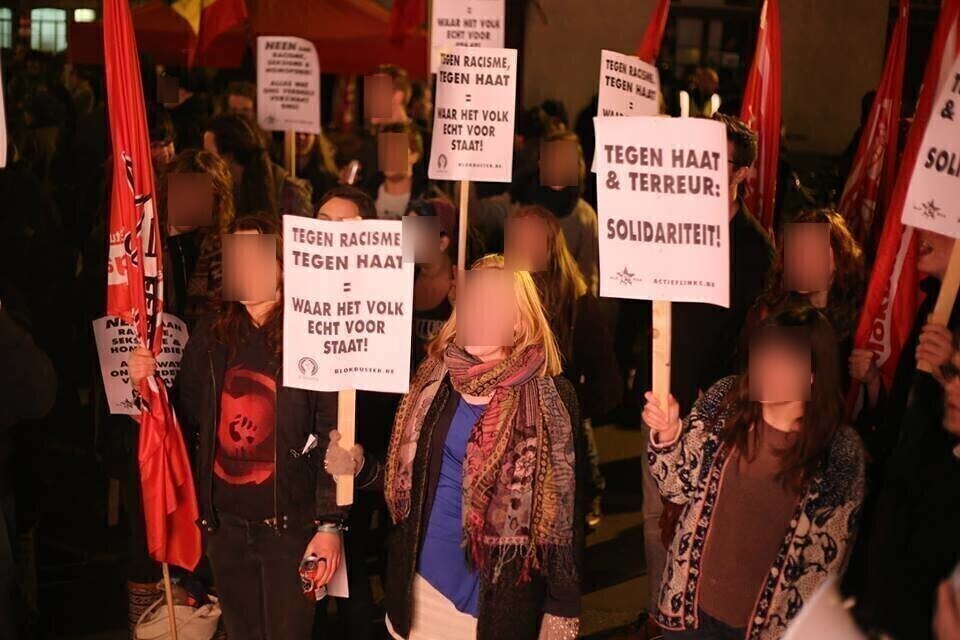
De 2007 à 2015, les affrontements se poursuivent dans les universités et les villes belges, les contre-manifestations antifascistes restant systématiquement plus nombreuses. Au cours de cette décennie, le NSV obtient un statut officiel dans les universités de Gand et de Louvain, tout en cultivant des liens avec l’extrême droite internationale, en accueillant des intervenants issus d’organisations extrémistes telles que le parti hongrois Jobbik, le groupe d’extrême droite et ultranationaliste HVIM (Mouvement de la jeunesse des soixante-quatre comtés), et en co-organisant des réunions auxquelles étaient conviées des personnalités telles que l’ancien dirigeant du KKK, David Duke. Certains de ces intervenants font l’objet d’interdictions de séjour dans plusieurs pays en raison de leurs activités racistes et antisémites. À cette époque, le NSV suscite également des critiques pour avoir exprimé ouvertement sa nostalgie de l’Afrique du Sud de l’apartheid, ses membres chantant « Ons Vir Jou, Suid-Afrika » et invitant des représentants d’Orania – une colonie réservée aux Blancs – à prendre la parole. À cette époque, le NSV a commence à remplir son rôle actuel : faire pression pour obtenir une reconnaissance institutionnelle et s’en servir pour donner une tribune aux acteurs et aux idées fascistes au sein des universités. Les antifascistes réagissent avec détermination à cette nouvelle acceptation institutionnelle du NSV : iels organisent des barrages, des manifestations et des campagnes pour empêcher les événements du NSV de se dérouler dans les rues de Flandre et dans les universités.
En 2007, le NSV défile à Anvers avec 300 participant·es face à 500 antifascistes. À la fin de leur manifestation, des membres du NSV saccagent le café « Markies de Sade » et blessent son propriétaire. En 2008, à Gand, le cycle s’intensifie : le NSV organise de nouveau sa manifestation annuelle, mais est dépassé en nombre par l’énorme contre-manifestation. 200 antifascistes s’en détachent et tentent de bloquer le NSV. La même année, en octobre, le NSV tente d’organiser sa première conférence à l’université de Gand, dans une faculté historiquement de gauche. Les étudiant·es antifascistes se mobilisent en grand nombre et parviennent à empêcher l’accès au NSV en barricadant le deuxième étage et l’entrée. Leur orateur, nul autre que Filip Dewinter, tente de se frayer un chemin à travers la foule, mais les étudiant·es tiennent bon et réussissent à bloquer l’accès du NSV à l’université. De violents affrontements éclatent, laissant un fasciste blessé à la tête.
En 2009, Louvain est également le théâtre de nombreuses actions ciblées contre le NSV. Le dirigeant du NSV, Arno D’Hooge, alors qu’il commandait des frites, est pris en embuscade et attaqué avec une chaîne de vélo et une bouteille ; la voiture de l’ancien dirigeant Gert Gillis est vandalisée, et des réunions du NSV sont attaquées, en réponse au passage à tabac de cinq étudiant·es par le NSV, à une agression contre un membre du COMAC et à de nombreuses perturbations de rassemblements de gauche. Cette intensification de la lutte autonome cette année-là est rendue nécessaire par l’acceptation institutionnelle croissante du fascisme : après 27 ans, l’université de Gand a officiellement reconnu le NSV, lui permettant ainsi d’accéder à des subventions et à des locaux universitaires.
À partir de 2010, une spirale de violences réciproques se poursuit parallèlement à l’ancrage institutionnel croissant du NSV. En 2010 et 2011, 700 antifascistes prennent le dessus sur les 300 membres du NSV à Anvers (2010) et à Gand (2011). Une fois de plus, lors de la manifestation à Anvers, certains antifascistes tentent de s’opposer au défilé du NSV, mais sont arrêtés par des policiers en civil. Lors de la manifestation de 2011 à Gand, les antifascistes se mobilisent pour lancer des bombes de peinture, des pierres et des œufs pourris. Certaines vitrines du quartier ne passent la nuit. La même année, les antifascistes mènent également des actions ciblées pour attaquer et perturber les réunions du NSV.
En 2013 à Louvain, 800 antifascistes affrontent le cortège fasciste de 300 personnes, certain·es se présentant masqués et armé·es de pierres et d’autres objets. Neuf personnes sont arrêtées pour cela. En novembre de la même année, le NSV de Louvain invite Laszlo Toroczkai à intervenir lors d’une conférence. Ce politicien hongrois d’extrême droite, interdit de séjour dans plusieurs pays pour ses propos racistes et antisémites ainsi que pour ses attaques contre les communautés roms, suscite une vive réaction antifasciste. Enfin, 2014 (Anvers) et 2015 (Gand) confirment la tendance : deux fois plus d’antifascistes que de fascistes. En 2015, les antifascistes concluent cette période par une victoire : la tentative du NSV d’accueillir Alexandre Douguine (connu pour s’inspirer de la Waffen SS) se heurte à une contre-mobilisation qui réussi à chasser le NSV des salles de l’université d’Anvers.
2016-2026 : Renforcement du réseau, opposition constante et perte de reconnaissance
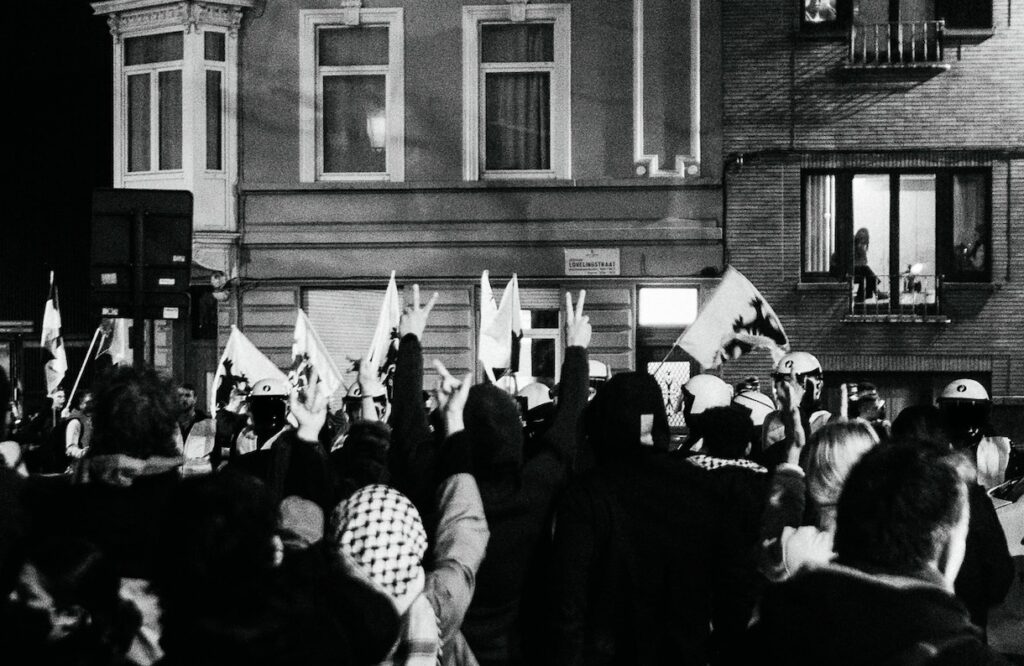
La seconde moitié des années 2010, malgré une reconnaissance institutionnelle relative, est difficile pour les fascistes. Leur marche attire de moins en moins de monde : en 2016 à Louvain, sous le slogan « pro grenzen, pro natie » (« pour les frontières, pour la nation »), seuls 150 participants sont présents (une estimation généreuse), alors qu’ils en attendaient 600. En réalité, leur escorte policière était plus nombreuse qu’eux. En réponse à l’intensité des contre-manifestations passées à Louvain, pas moins de 200 policiers, dont 100 renforts venus de l’extérieur de Louvain, ainsi qu’un hélicoptère ont été déployés. Comme d’habitude, la contre-manifestation rassemble plus du double de participant·es, avec 400 antifascistes. La présence policière massive rend toutefois rendu impossibles toute action ciblée et toute confrontation.
L’année 2017 est encore pire pour le NSV : moins de 100 personnes, dont un important groupe de sécurité de Voorpost, est présent à leur marche « Europa ontwaakt » (« L’Europe se réveille ») à Berchem. Même RechtsActueel n’a fait état que de 80 à 90 personnes. Une marche contre le racisme a lieu malgré l’interdiction prononcée par Bart De Wever. La contre-manifestation rassemble 250 camarades issus d’une grande diversité de participants et d’organisations : Antifa Anvers, un groupe d’étudiant·es de Comac à Louvain, Anvers et Bruxelles, des militant·es cachemiris et tamouls, ainsi que Women Against Fascism and Racism Anvers. Après leur mobilisation, en 2018, après 25 ans de contre-mobilisations antifascistes, aucune marche du NSV n’a lieu.
Ce n’est qu’un répit temporaire. Face à la popularité croissante, au sein de l’extrême droite européenne au sens large, de la théorie du complot du « grand remplacement », le NSV appelle en 2019 à une marche en faveur de la « remigration », faisant référence au nettoyage ethnique par le biais de l’expulsion massive des populations minoritaires non blanches, en particulier des immigrés et parfois même des citoyen·nes nés dans le pays, vers leur lieu d’origine. Le NSV mobilise 150 personnes, les antifas 400. La contre-manifestation « en solidarité avec tout·es celleux qui sont marginalisé·es » est organisée par une coalition de 10 organisations de gauche.
Aucune manifestation n’a lieu pendant la période de pandémie, entre 2020 et 2023, mais le NSV reste actif. En 2021, ses membres effectuent un petit voyage pour manifester leur soutien à leurs amis suprémacistes blancs de Génération Identitaire, un groupe interdit en France pour ses discours racistes. En 2022 et 2023, ils invitent Filip Dewinter et Martin Sellner à prendre la parole lors de leurs événements. Le premier, l’un des dirigeants du Vlaams Belang, est invité à Anvers pour parler de son livre sur la théorie du grand remplacement. Une pétition contre cet événement receuille un grand nombre de signatures, mais la conférence est tout de même autorisée sous prétexte de « liberté d’expression ». Une centaine de militant·es se rassemblent pour manifester le jour de la conférence, mais sont tenus à distance par les forces de police. Un·e antifasciste rusé réussi toutefois à se faufiler à l’intérieur et à jeter de l’eau sur Dewinter depuis l’étage supérieur. L’année a été rude pour Filip : plus tôt dans l’année, il avait été projeté au sol par un·e militant·e et aspergé d’un liquide pestilentiel à Louvain, lors d’une conférence sur ce même livre. Martin Sellner, invité l’année suivante par le NSV à Louvain, est une figure de proue de la « théorie du grand remplacement » dans le milieu fasciste européen. C’est un militant néonazi, fondateur de la branche autrichienne de Génération Identitaire, et fier bénéficiaire de dons de la part de l’auteur de l’attaque terroriste de 2010 contre deux mosquées à Christchurch. La KULeuven tente d’annuler l’événement, mais le NSV se tourne vers les tribunaux pour obtenir de l’aide, réussissant à tirer parti du système juridique et à empêcher l’annulation. Une quarantaine de militant·es se rassemblent à la gare de Louvain et défilent jusqu’à l’auditorium. En chemin, ils croisent Dries Van Langenhove : une altercation éclate avec l’entourage de ce dernier. Après la conférence de Martin Sellner, plusieurs participants posent pour une photo avec lui dans l’auditorium en faisant des gestes suprémacistes blancs.
Les deux dernières années, 2024 et 2025, sont mouvementées pour le NSV, le climat politique ambiant devenant de plus en plus favorable à un fascisme institutionnalisé. Les antifascistes réagissent en conséquence. Lorsque Dries van Langenhove est invité à donner une conférence le 28 février 2024, une semaine seulement avant le procès contre Schild & Vrienden (dont Langenhove est le principal accusé) pour incitation à la violation des lois contre le racisme et le négationnisme. Une pétition pour s’y opposer recueille plus de 500 signatures en 3 jours, dont celles de nombreux professeurs de l’université. Dans son discours, il présente les « Africains noirs » comme inférieurs aux « Flamands blancs et aux Européens » et dépeint les femmes roms comme des voleuses. 150 personnes sont rassemblées pour protester, ce qui conduit la KULeuven à interdire les événements du NSV dans ses bâtiments jusqu’à la fin de l’année 2025 et à porter plainte contre Van Langenhove.
Cet événement n’est pas resté sans conséquences pour le NSV : 150 personnes se rassemblent pour manifester contre la conférence et critiquer l’université de l’avoir autorisée. La KULeuven vote ensuite l’interdiction des événements organisés par le NSV dans ses locaux, au moins jusqu’à la fin de l’année 2025, et porte plainte contre Dries Van Langenhove. LOKO, l’organisation représentant l’ensemble des étudiants de Louvain, cesse de reconnaître le NSV à la suite de cette conférence. En avril de la même année, le NSV organise une marche en faveur de l’indépendance flamande, de la théorie du remplacement et de la remigration. Elle rassemble environ 200 à 250 personnes, avec des délégations venues des Pays-Bas, de Bretagne et d’Autriche. Les manifestants défilent dans les rues au son de tambours rappelant le mouvement des Jeunesses hitlériennes, et concluent leur manifestation par un chant sud-africain de l’apartheid. La manifestation antifasciste habituelle est organisée le même jour à Anvers par une coalition de dizaines d’organisations de gauche réunies sous le slogan « Solidarité. Pas de haine. ». Et comme toutes les années précédentes, les antifascistes surpassent le NSV en nombre avec 500 participant·es.
Une deuxième marche pour la remigration, intitulée « Remigration – Stop au remplacement », se déroule à Anvers en septembre 2024 à l’initiative de Voorpost, avec la participation du NSV, du Projet Thule, de Schild & Vrienden et du Geuzenbond. Un petit groupe d’antifascistes brandissent une banderole sur laquelle on pouvait lire « Pas de frontières, pas de nations, au diable les expulsions » tente de bloquer le cortège. Les antifascistes se mobilisent une nouvelle fois en décembre lorsque le NSV a de nouveau invité Dewinter à donner une conférence sur son livre consacré à la théorie du grand remplacement à la faculté de droit de l’UHasselt, où se trouve toujours une plaque commémorative en hommage aux résistant·es emprisonnés pendant l’occupation. Iels font pression sur l’université pour que la conférence soit annulée, sans succès : elle est simplement déplacée vers un autre lieu.
Le NSV déploie beaucoup d’efforts pour mobiliser ses partisans en vue de sa « marche pour le retour » l’année dernière, en 2025. Il lance un appel international et sollicite le soutien institutionnel de Martin Sellner et du chef du Vlaams Belang, Tom Van Grieken. Ils parviennent à rassembler 400 personnes, mais se heurtent à l’un des déficits numériques les plus extrêmes de la décennie : une « Marche pour la solidarité » organisée dans un autre quartier de la ville rassemble plus de 1 000 contre-manifestant·es, un mélange d’activistes, de syndicats et de partis. Comme au début des années 2000, la marche autorisée est accompagnée de tentatives d’une centaine d’antifascistes visant à la bloquer physiquement. Une présence policière massive, avec des renforts venus d’autres villes, des unités spécialisées, des canons à eau et un hélicoptère, empêche la mise en place d’un blocage cohérent. La police poursuit les manifestant·es dans les ruelles et utilise des canons à eau pour disperser la foule. Le Marimain, un bar fréquenté par des militants de gauche, est visé directement par le canon à eau de la police. Bien qu’il n’y ait pas eu de blocage important, plusieurs perturbations spontanées se produisent : des feux sont allumés, des projectiles lancés. Divers groupes arrivent à suivre le cortège, se mêlant à la foule venue manifester. De nombreux passant·es, ainsi que les antifascistes mobilisés, se sont joints à la foule, se rassemblant à chaque coin de rue sur le parcours du défilé du NSV. Ils sont accueillis par des huées et des slogans antifascistes tout au long de leur parcours. Des œufs, des feux d’artifice et d’autres objets sont lancés, et de petites barricades sont érigées et incendiées ici et là. Plus de 20 personnes sont arrêtées cette nuit-là. Plus tard dans l’année, le NSV perdson statut officiel à l’université de Gand (UGent) à la suite d’une publication transphobe sur Instagram qualifiant la rectrice Petra De Sutter d’« homme ». La mobilisation antifasciste de mars pèse dans cette décision : les médias indépendants diffuse des images montrant des saluts nazis et d’autres signes de suprématie blanche lors de leur marche, mettant ainsi en évidence leur immense impopularité auprès du public.
Le combat continue
Cette année, le jeudi 26 mars, le NSV se rassemble une fois encore à Louvain, la même ville où se sont produits les blocages spectaculaires de 2003, quand la marche fût arrêtée pendant plusieurs heures.
Ils partiront de la place Herbert Hooverplein — ce qui semble être un clin d’œil au lieu de départ d’une manifestation de 1941 du Vlaams Nationaal Verbond, principale force du collaborationnisme flamand entre 1933 et 1945, à laquelle ils rendent également hommage avec le design de leurs horribles casquettes.
Alors que nous nous préparons à nous retrouver à Louvain la semaine prochaine pour poursuivre cette lutte vieille de 40 ans, quelles leçons devrions-nous tirer de l’histoire ?
Le mouvement antifasciste en Flandre, à travers 40 ans d’histoire, a été constant, idéologiquement pluriel et engagé, mais ces 40 années ont aussi été marquée par une progressive tolérance instutionnelle pour le fascisme. Le NSV, et plus largement les mouvements fascistes explicitement présents en Flandre, n’a jamais agi de manière isolée. Sa capacité à défiler, à s’organiser et à se développer a entièrement dépendu du soutien apporté par les structures politiques et institutionnelles.
La répression étatique et les concession croissantes accordées par les universités ont été les facteurs déterminants qui ont permis à une formation fasciste relativement modeste de maintenir une présence visible et continue. Nous pouvons puiser notre inspiration dans le fait que, face à ces obstacles toujours plus nombreux, les antifascistes ont, au fil des décennies, tissé des liens entre les villes et les mouvements, entretenant ainsi une culture de la résistance aussi variée que résiliente. Les manifestations de masse, les barrages, les actions de perturbation, la satire et les affrontements physiques ont tous joué leur rôle. Bien sûr, ces différentes tactiques et logiques politiques n’ont pas toujours coexisté sans heurts. Le clivage entre réformistes et autonomes n’est pas nouveau : il était tout aussi manifeste dans la prise de distance de Blokbuster vis-à-vis des anarchistes lanceurs de pierres en 2003 qu’en octobre 2025, lorsque Bert Engelaar, dirigeant de l’ABVV, s’est engagé à remettre à la police les tracts distribués par le bloc révolutionnaire pendant la grève nationale.
Il ne faut pas oublier que certains des moments les plus décisifs de cette histoire se sont produits lorsque des groupes autonomes, désavoués par les acteurs réformistes, ont agi selon leurs propres termes. À ces moments-là, les tactiques de perturbation ont pu être pleinement mises à profit, comme lors des blocages de 2003. La mobilisation de masse a également joué un rôle déterminant, comme l’a montré l’absence de défilé du NSV en 2000 après l’immense contre-mobilisation de l’année précédente. La leçon essentielle à en tirer est la suivante : la résistance antifasciste est la plus forte lorsqu’elle combine une mobilisation de masse à grande échelle avec une véritable perturbation – mais pas lorsque la confrontation est édulcorée pour plaire à un public plus large. Différentes tactiques sont nécessaires, mais organiser de grandes mobilisations ne doit pas signifier chercher l’approbation des institutions et des logiques libérales qui ont aidé le NSV et le fascisme en général à s’enraciner davantage.
Cette année, pour poursuivre la lutte, nous devons former une masse intransigeante. Nous avons besoin d’autant d’antifascistes et d’alliés que possible dans les rues, prêts à agir avec détermination, créativité et une multitude de tactiques. Préparez-vous pour la soirée du 26 à Louvain, et n’oubliez pas : notre force ne réside pas seulement dans notre nombre, mais dans le courage de perturber, d’affronter et de refuser les limites imposées par les logiques libérales complices. Cette année, c’est à notre tour de porter plus loin cette lutte vieille de 40 ans – et de reprendre en chœur le slogan : Geen fascisten in onze stad !
Pour plus d’informations : T.ME/ANTI_NSV
Een verhaal van Vlaams antifascisme: 40 jaar verzet tegen NSV
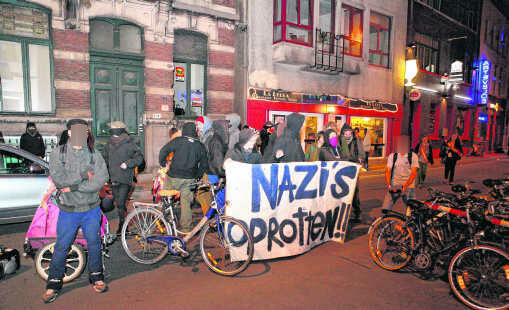
Op 26 maart 2026, zal de Nationalistische Studentenvereniging, ook gekend onder de naam NSV, opnieuw een oproep doen voor een mars door een Vlaamse stad- dit jaar Leuven- onder de naam van het racistische modewoord « remigratie », een begrip die verwijst naar massale deportaties die men probeert te normaliseren. Elk jaar organiseert de belangrijkste fascistische studentenorganisatie van Vlaanderen deze mars, afwisselend in drie grote Vlaamse steden: Antwerpen, Gent, en Leuven. Met deze optocht brengen ze een coalitie samen van nationalisten, racisten, en fascisten uit heel Vlaanderen, Wallonië en zelfs de bredere Europese extreemrechtse hoek.
Ze proberen zo de straten op te eisen met een betoging die is uitgegroeid tot een vaste afspraak op de kalender van het Vlaams, en steeds meer internationale, fascisme.
De 40-jarige geschiedenis van deze marsen, is echter ook een geschiedenis van verzet. Al sinds het begin worden de pogingen van NSV om de Vlaamse straten op te eisen beantwoord met allerlei vormen van tegenstand: van rotte eieren en pogingen om hen te overstemmen met muziek, tot brandende blokkades en felle rellen.
Dit aanhoudende verzet komt voort uit het besef dat deze mars geen gewone studentenbetoging is, en dat ook nooit is geweest. De NSV probeert zich de laatste jaren voor te doen als een onschuldige nationalistische groep, maar verspreidt al decennialang openlijk racistische inhoud in haar publicaties, pleegt zelf fysieke aanvallen op geracialiseerde mensen, en biedt binnen universiteiten een podium aan enkele van de meest uitgesproken fascistische acteurs in Europa en daarbuiten, van het Vlaams Belang tot de Ku Klux Klan.
De NSV ontstond in 1976 in Antwerpen, als extreemnationalistische afsplitising van het KVHV, een rechte katholieke studentenorganisatie,en groeide vervolgens uit tot een centrale speler binnen het Vlaamse extreemrechtse netwerk. Deccenialang was ze een ideologische kweekvijver en rekruteringsbasis voor het Vlaamse Blok, en zijn opvolger Vlaams Belang, waaruit heel wat kopstukken zijn voortgekomen. De organisatie nodigt regelmatig Belgische en internationale extreemrechtse figuren uit, onder andere Dries Langenhove en Martin Sellner. Tegelijk onderhouden ze banden met meer marginale racistische groupen zoals Voorpost en Schild & Vrienden.
Die positie, tussen parlementaire politiek en straatfascisme, weerspiegelt zich ook in de NSV-mars. Politici van Vlaams Belang, internationale sprekers en georganiseerde fascistische groepen uit binnen-en buitenland komen er elk jaar samen. Elk jaar opnieuw brengt die mars alle strekkingen binnen extreemrechts samen op Vlaamse straten, met speeches overdag, maar met geweld en neonazistische knokploegen in de nacht.
Natuurlijk heeft de NSV deze betogingen nooit zonder hevig verzet kunnen organiseren. Jaar na jaar mobiliseren antifascisten, studentenorganisaties en bredere linkse bewegingen om hen tegen te gaan. De geschiedenis van de jaarlijkse NSV betogingen laat een lange levende traditie van antifascistisch verzet in Vlaanderen zien. Niet alleen tegen het fascisme zelf, maar ook tegen de repressie die keer op keer plaatsvindt. De tegenacties tegen deze mars hebben heel links samengebracht, van partijpolitieke groepen tot autonome collectieven, en gebruikten allerlei tactieken: blokkades, massabetogingen, lawaai, projectielen, en soms regelrechte rellen. Het was zelden een gelijke strijd. De NSV trekt er onder bescherming van de politie en gewelddadige straatfascisten op uit, omringt door barrières en escortes, terwijl tegenbetogers vaak het eerste slachtoffer zijn van geweld en repressie. Ondanks dat onevenwicht hebben de Toch hebben antifascisten de NSV nooit de straten laten controleren zonder tegenstand.
Keer op keer waren ze met meer, overstemde ze, vernederende ze en verstoorde ze de pogingen van de NSV om zich als een zelfzekere macht te presenteren. In sommige jaren, zoals 2000, 2015 en 2018, was de druk van het voorgaande jaar zelfs groot genoeg om de mars helemaal te doen aflasten.
De geschiedenis van de NSV-mars is dus niet alleen de geschiedenis van fascistische mobilisatie, maar ook van het koppige weigeren om dit ongestoord te laten gebeuren. Al deccenialang trekken antifascisten elk jaar opnieuw de straat op om de mars tegen te houden en duidelijk te maken dat de NSV, hoe goed de straat hen ook beschermt, nooit ongestoord zal kunnen marcheren.
1980-1995 de eerste jaren van het verzet tegen NSV
In 1976 wordt het NSV opgericht als een splinterorganisatie van KVHV in Antwerpen, twee jaar later wordt NSV Gent opgericht. De fascistische organisatie was meteen impopulair: er waren protestmarsen tegen het NSV voordat het NSV zelf protestmarsen begon te organiseren. Op 5 februari 1980 organiseert het AFF (Antifascistisch Front) en het VVS (Vereniging van Vlaamse Studenten) een betoging met 750 aanwezigen. Vanaf de 1980 onstaat er ook in Leuven een beweging tegen NSV. De jaren ’80 zijn de jaren van de spanningen in de Voerstreek, De Bende van Nijvel, de CCC en de punkbeweging. De Vlaamse beweging leeft en acties van NSV krijgen ook mainstream persaandacht.
Tot 1982 was het NSV een erkende studentenvereniging aan de Universiteit Gent, waardoor ze dus events konden houden in de campus en kosten terugbetaald krijgen zoals flyers. Daarna werden ze buiten gezet na een gewelddadige confrontatie met links. In 1981 wordt de Leuvense afdeling van NSV opgericht. Op 2 februari 1981 hield NSV een pro-apartheid meeting in Gent in de Blandijn. Samen met het AFF hield VVS een verboden demonstratie tegen racisme en apartheid. Wanneer de manifestanten aankwamen bij de Blandijn ontstonden er rellen. De politie trad hard op, vooral tegen de antifascisten, verschillende werden opgepakt en een ervan bleef voor langere tijd in hechtenis. In de dagen na de demonstratie was er een pamflettenoorlog tussen links en rechts om het narratief rond de clash. Op 2 februari 1983 hield NSV opnieuw een meeting rond Zuid-Afrika in de Blandijn in Gent. Voor het verzet werd er deze keer gekozen voor een andere techniek, en leden van het AFF en VVS blokkeerden de verschillende ingangen tot het gebouw op voorhand met fietssloten, waardoor de rechtsnationalisten hun meeting ergens anders dienden te organiseren.
In 1984 verneemt NSV Leuven dat ze geen subsidies zullen ontvangen van de Algemene Studentenraad. Op 8 maart dat jaar bezet de organisatie het cultureel centrum Stuc, toen nog op de campus sociale wetenschappen. Al snel verzamelden er zich honderden studenten voor een spontaan protest tegen de bezetting. Sommigen hadden eieren mee, NSV wapende zich ondertussen met stokken en stukken gas- en waterleidingen die ze uit het gebouw hadden gehaald en loopt met een groep van 40 op de menigte in. Dit onder aanleiding van praeses Jurgen Ceder (later Vlaams Blok en N-VA lid en jurist van het omstreden 70-puntenplan), die volgens een getuige in studentenblad Veto « zijn mening regelmatig uitte met boksbeugel en fietsketting ». Een student raakt zwaargewond aan zijn scheenbeen na een gerichte karatetrap door Ceder, die volgens verschillende getuigen die klacht neerlegden, geidentificeerd werd. Het slachtoffer houdt er een levenslang letsel met complicaties aan over. Ceder werd uiteindelijk vrijgesproken door gebrek aan bewijs.
Op 3 februari 1984 neemt NSV’er en VMO’er Luc Onbekent met een mes een moordpoging op een Marokkaanse man op cafe in Sint-Niklaas door hem drie keer in de keel te steken. In 1984 volgt er nog een aanval op een cafe in Brugge door een NSV commando met drie gewonden en ervoor ook een geweldadige passage van NSV bij een homobar. Toen dit commando opgepakt werd door de politie vond met ketting, negen wapenpatronen, een lijst met Duitse contactadressen en Duits geld. In 1985 worden twee actievoerders van het ‘Boycot Apartheidskomitee’ door de NSV in elkaar geslagen. Op 5 december 1985 bezoekt de NSV met een groep van 45 de Vrije Universiteit Brussel (VUB) om hun blad te verkopen en lokken ze gevechten uit waarbij ze gebruik maken van matrakken en boksijzers. Meer dan honderd VUB studenten verzetten zich hiertegen spontaan.
Op 27 februari 1986 betogen 300 NSV’ers in Gent onder het motto « t is mijn volk, blijf eraf », mogelijks hun eerste eigen manifestatie. Andere aanwezige groepen zijn VMO, Nationaal Front, ODAL en Were Di. Vlaams Blok riep op voorhand ook op om mee te doen aan de manifestatie. Er was een tegenbetoging van AFS (Antifascistische Samenwerking) met eveneens 300 personen die aandrong op een verbod van het NSV. Toen de betoging van het NSV passeerde langs het anarchistisch lokaal kwam het tot een licht gevecht.
In juni 1989 vieren een 30-tal NSV studenten de honderste geboortedag van Adolf Hitler in Antwerpen, de eigenaar van de bar Het Kroegske, eveneens ex-praeses van het NSV, droeg voor de gelegenheid een tshirt van de Ku Klux Klan. In oktober 1990 komen de Antwerpse, Brusselse en Leuvense afdelingen van de NSV naar Gent waar ze aan het studentenrestaurant De Brug fyers verspreiden. Een MLB-lid wordt hierbij hard aangepakt. Na deze zoveelste aanvaring met het NSV herbevestigt het Politiek en Filosofisch Konvent het verbod van racistische en fascistische verenigingen, zoals de NSV, aan de Universiteit van Gent.
Op 20 februari 1992 houdt NSV opnieuw een manifestatie in Leuven. Linkse organisaties vragen een verbod van de betoging en er worden 1000 brieven verzameld van Leuvenaars tegen de NSV betoging. Van NSV was er een opkomst van 500 personen, met ook delegaties uit Nederland en Frankrijk, er waren vier tegenbetogingen die georganiseerd werden. Er zouden ook 50 paracomandomilitairen uit Tielen deelgenomen hebben aan de NSV betoging. Uiteindelijk gingen de verschillende tegenbetogers rond het parcours van NSV. NSV gooide met voetzoekers, tegenbetogers met vuilzakken en eieren. De tegenbetogers scholden NSV uit voor nazis, en een van de betogers antwoordde dat ze hier fier op waren. Op het einde van de betoging werd een kleine groep van NSV Leuven beschermd door te politie tegen de acties van de tegenbetogers. Al bij al verliep de avond vrij rustig (Bron: Veto Jaargand 18, nummer 19 en 20).
Op 22 Februari 1994 is er een gevecht in de cafetaria van de VUB tussen 25 NSV’ers en VUB studenten, nadat die eerste aan het afficheren waren en hakenkruizen schilderden op de campus. De NSV studenten startten de aanval onder het scanderen van de slogan « chargeren » (bron: artikel De Morgen, 23/02/1994). Deze descenia tijdens de opkomst van het NSV waren norg maar het begin van een lange strijd die zou intensificeren de jaren erop. Tijdens deze jaren werd NSV hun reputatie aangetast door verschillende controverses en onpopulariteit, wat hun zoektocht to institutionele erkenning bemoeilijkte.
1996 – 2005: ‘Geen fascisten in onze stad!’: een intensievere strijd op straat
Naarmate het decennium ten einde liep, begonnen de mobilisaties van de NSV af te nemen, zowel door de jarenlange tegenstand als door de afnemende aantrekkingskracht van het fascisme. Het antifascistische verzet tegen hun optochten nam alleen maar toe, ondanks de toenemende staatsrepressie die de fascisten hielp beschermen. In 1996 marcheerden ongeveer 700 NSV-fascisten door de stad. Enkele honderden tegendemonstranten van Leuven Fascisme Vrij en Aktiefront Stop Fascisme gingen de straat op, ondanks een verbod van de burgemeester, nadat ze de avond ervoor het studentenrestaurant Alma hadden omgetoverd tot een nep-militaristische controlepost om de door de NSV en het Vlaams Blok beoogde wereld te tonen en te satiriseren. Veel antifascisten werden in administratieve hechtenis genomen nadat ze door meer dan 200 politieagenten waren omsingeld. Tegen 1998 was het aantal NSV-leden in Gent gedaald tot ongeveer 200, tegenover 500 tegendemonstranten. Antifascisten confronteerden hen al vóór de mars en raakten hevig in strijd met de politiebarricades die waren ingezet om de fascisten te beschermen: 41 demonstranten werden gerechtelijk gearresteerd.
De omvang en de heftigheid van de tegendemonstraties bereikten rond de eeuwwisseling een hoogtepunt: in 1999, opnieuw in Leuven, werden de amper 200 NSV-aanhangers spectaculair in de minderheid gesteld door zo’n 1.500 tot 2.000 tegendemonstranten, tijdens twee afzonderlijke demonstraties die waren georganiseerd door de PVDA en het Collectief tegen Fascisme, en die de staat beide had proberen te verbieden. Een eerste confrontatie brak uit toen de tegendemonstranten zich van de Blijde Inkomsstraat naar de Tiensestraat verplaatsten, onder het scanderen van: “Wij mogen niet betogen van Tobback, de extreem-rechtsen wel”. Er werden stenen gegooid en er werd gevochten in de Maria Theresiastraat en de Bogaardenstraat, waarna 170 arrestaties volgden. Sommige bijzonder standvastige antifascisten konden pas worden weggevoerd door zes agenten per persoon; één zou gewapend en klaar voor actie zijn geweest met een honkbalknuppel. Naarmate de nacht vorderde, staken de antifascisten vuurtjes aan, slingerden stenen en met rode verf gevulde gloeilampen en lieten vuurwerk af. Eén politieauto in de Blijde Inkomststraat raakte zijn ruiten kwijt.
In de jaren daarna had de NSV moeite om haar toch al slinkende ledenaantal weer op peil te brengen. Er is geen informatie over een mars in 2000, wat doet vermoeden dat de organisatie na de verpletterende nederlaag van het jaar daarvoor simpelweg de moed had verloren om er een te organiseren. In 2001 keerden ze echter terug naar Antwerpen. Dit jaar werd de mars niet alleen overstemd door ongelooflijk luide reggaemuziek die uit een studentenflat op de Ossenmarkt klonk, maar werd de klassieke slogan “Geen fascisten in onze stad!” ook gezongen door studenten-tegenbetogers uit alle drie de grote Vlaamse steden en uit Brussel, met merkbare steun van Franstalige studenten van de ULB.
In 2002 speelde zich in Gent op straat de bekende kloof af tussen de aan vakbonden en politieke partijen gelieerde linkse activisten en de meer autonome vleugel van het antifascisme. Het “United Colours Committee”, een platform van antiracistische studenten gesteund door de ABVV en ACV, riep op tot een vreedzame demonstratie van het Sint-Annaplein naar de Oude Beestenmarkt. Later die avond riep de antifascistische campagne Blokbuster op tot een aparte tegendemonstratie, waarbij zo’n 800 mensen werden gemobiliseerd om de mars van 200 NSV’ers in de minderheid te brengen. Enkele autonome demonstranten splitsten zich af en probeerden de NSV rechtstreeks te confronteren. De oproerpolitie blokkeerde deze pogingen om de fascisten te bereiken in de buurt van Kantienberg, waar stenen en flessen naar de politiebarricades werden geslingerd. De politie ging in de aanval met een klein leger van 250 agenten, ondersteund door een helikopter en twee waterkanonnen. Er volgden ongeveer 40 administratieve aanhoudingen, maar veel antifascisten wisten via de zijstraatjes van de stad te ontsnappen. Zeven ramen in de Vlaanderenstraat hebben de avond niet overleefd.
In 2003, terug in Leuven, wist de NSV slechts 250 demonstranten op de been te brengen, opnieuw in de minderheid ten opzichte van zo’n 700 tegendemonstranten. In de aanloop naar de demonstratie nam Blokbuster-woordvoerder Sven De Deken publiekelijk afstand van de stenengooiers van voorgaande jaren en benadrukte hij dat de meer confronterende vleugel zich apart zou mobiliseren. Wat de realiteit van deze splitsing ook moge zijn, de aanwezigheid van een meer geconcentreerde, confronterende groep anarchisten en krakers bleek effectief. In de Tiensestraat en de Vesaliusstraat werden twee barricades van banken, stoelen en oude fietsen opgericht, van waaruit de politie werd bekogeld met stenen, verf, eieren, brandende fakkels en naar verluidt zelfs molotovcocktails, waardoor één agent met een gewond been wegstrompelde en verschillende politieauto’s beschadigd raakten. De NSV bracht een groot deel van de avond door met het overstemmen van een schreeuwpartij, meer dan een uur vastzittend achter de barricades. Hun mars kwam nauwelijks tot het einde, urenlang opgehouden terwijl de politie probeerde de weg vrij te maken, waarbij hun waterkanon vast kwam te zitten op de barricades. De NSV hervatte de mars ruim na 21.00 uur, na lang wachten tot de politie een pad voor hen had vrijgemaakt. 21 tegendemonstranten werden gearresteerd. In datzelfde jaar probeerde de NSV, in een poging hun waardigheid terug te winnen, een spandoek te ontvouwen in Zaventem. Er was geen tegenmobilisatie nodig, want ze werden verslagen door hun eigen spandoek, dat te moeilijk voor hen was om uit te vouwen. Later dat jaar kwamen ze opnieuw onder vuur te liggen in de media omdat ze op de verjaardag van de Kristallnacht een concert hadden georganiseerd met een Nederlandse neonaziband.
In 2004 kwamen tussen de 100 en 250 NSV’ers bijeen in Antwerpen, waar ze in de minderheid waren tegenover 400 tot 600 tegendemonstranten. De confrontaties waren dit jaar minder heftig, hoewel er enkele schermutselingen plaatsvonden in de buurt van het station van Berchem. Een week eerder hadden linkse studenten geprotesteerd tegen het gebruik van een zaal aan de KULeuven, waarbij ze de klassieker “Geen fascisten in onze stad!” scandeerden, als onderdeel van een voortdurende strijd om de NSV uitgesloten te krijgen van het universiteitsleven aan de KULeuven. Later dat jaar werden ze ook in Gent geconfronteerd met linkse activisten tijdens hun demonstratie tegen de toetreding van Turkije tot de Europese Unie, waarbij op het Sint-Pietersplein gevechten uitbraken en de politie met waterkanonnen moest ingrijpen. Ook hier was de NSV in de minderheid: 600 antifascisten tegenover 180 demonstranten.
In 2005 vond de mars van de NSV ongewoon laat plaats, namelijk in Gent. Dit jaar kwamen er 500 deelnemers op de been, die in de minderheid waren ten opzichte van 600 tegendemonstranten. Ook dit jaar namen krakers en anarchisten weer het voortouw bij de autonome tegenacties; ze deelden al weken van tevoren pamfletten uit, wat de politie erg ongerust maakte. Hun bezorgdheid was terecht: op het Fochplein werd een agent met een betonblok op het hoofd geraakt. Ondertussen braken groepen skinheads die met de NSV meeliepen uit de stoet en vielen willekeurig mensen op straat aan. Er braken rellen uit, waarbij een bus van de NSV met stenen, ijzeren staven en betonblokken werd bekogeld. De politie vond later dozen met rookbommen, molotovcocktails en knuppels langs de route van de demonstratie, vermoedelijk geplaatst door de anarchisten, wat opnieuw een nieuw niveau van voorbereiding aantoonde.
Buiten de straten breidde het verzet zich uit naar het universiteitsleven, zowel in institutionele strijd als in fysieke confrontaties. De aanhoudende klachten van de NSV over hun uitsluiting van de PFK van de Universiteit Gent (en de bijbehorende financiële subsidies) leidden tot herhaalde botsingen. In 1997 verstoorden ze een PFK-vergadering, maar werden ze verdreven door linkse studenten gewapend met stokken. Hoewel de verhalen verschillen over wie het eerst sloeg, werden twee linkse studenten geslagen en gearresteerd door de politie, wat leidde tot een protest tegen zowel de NSV als de politie, waarbij demonstranten riepen: “We zullen nooit toestaan dat de NSV wordt toegelaten tot de PFK.”
Vijf jaar later, in 2002, deed zich een soortgelijke confrontatie voor: de NSV bestormde een bijeenkomst, maar werd opnieuw fysiek tegengewerkt door antifascistische studenten. Volgens de huidige website van de PFK staat de NSV nu vermeld als aangesloten organisatie, wat suggereert dat deze institutionele strijd eindigde in een concessie van de instelling. Deze uitkomst – net als veel van de zogenaamde ‘successen’ van de NSV, zowel op straat als binnen universiteiten – lijkt grotendeels afhankelijk van institutionele en staatssteun. Maar zelfs met deze voorsprong werd de NSV door aanhoudende antifascistische druk rond de eeuwwisseling voortdurend uitgedaagd, in het nadeel gebracht, in de minderheid gedrongen en publiekelijk vernederd.
2007-2015: Institutionele erkenning en antifascistische strijd in de universiteiten
Van 2007 tot 2015 bleven de confrontaties aanhouden in Belgische universiteiten en steden, waarbij de antifascistische tegendemonstraties nog steeds consequent in de meerderheid waren. Gedurende dit decennium verwierf de NSV een officiële status aan de universiteiten van Gent en Leuven, terwijl ze tegelijkertijd internationale extreemrechtse connecties onderhield, sprekers uit extremistische organisaties zoals de Hongaarse Jobbik-partij en de extreemrechtse en ultranationalistische groep HVIM (Jeugdbeweging van de Vierenzestig Provincies) ontving, en events mee organiseerde waar figuren zoals voormalig KKK-leider David Duke werden uitgenodigd. Sommige van deze sprekers hadden een inreisverbod in meerdere landen vanwege racistische en antisemitische activiteiten. In deze periode kreeg de NSV ook kritiek omdat ze luidkeels hun nostalgie naar het apartheidsregime in Zuid-Afrika uitten, waarbij leden “Ons Vir Jou, Suid-Afrika” zongen en vertegenwoordigers van Orania – een nederzetting uitsluitend voor witte mensen – uitnodigden om te spreken. De NSV begon in deze periode haar huidige rol te vervullen: aandringen op institutionele erkenning en deze gebruiken om fascistische actoren en ideeën een platform te bieden binnen universiteiten. Antifascisten reageerden vastberaden op deze nieuwe institutionele acceptatie van de NSV: ze organiseerden blokkades, protesten en campagnes om te voorkomen dat NSV-evenementen plaats zouden vinden in de straten van Vlaanderen en op de universiteiten.
In 2007 hield de NSV in Antwerpen een mars met 300 deelnemers, tegenover 500 antifascisten. Leden van de NSV vernielden aan het einde van hun demonstratie het café “Markies de Sade” en verwondden de eigenaar. In 2008 in Gent versterkte de cyclus zich: de NSV organiseerde opnieuw haar jaarlijkse demonstratie, maar werd in de minderheid gesteld door de massale tegendemonstratie. 200 antifascisten splitsten zich hiervan af en probeerden de NSV te blokkeren. In oktober van datzelfde jaar probeerde de NSV haar eerste lezing te houden aan de Universiteit Gent, in een van oudsher linkse faculteit. Antifascistische studenten kwamen massaal in actie en wisten de NSV de toegang te ontzeggen door de tweede verdieping en de ingang te barricaderen. Hun spreker, niemand minder dan Filip Dewinter, probeerde zich een weg door de menigte te banen, maar de studenten hielden stand en wisten de NSV met succes buiten de universiteit te houden. Er braken hevige confrontaties uit, waarbij één fascist een hoofdwond opliep.
Ook in Leuven vonden in 2009 talrijke gerichte acties tegen de NSV plaats. NSV-leider Arno D’Hooge werd, terwijl hij frietjes bestelde, overvallen met een fietsketting en een fles; de auto van voormalig leider Gert Gillis werd vernield en NSV-bijeenkomsten werden aangevallen, als reactie op het in elkaar slaan van vijf studenten door de NSV, een aanval op een lid van COMAC en talrijke verstoringen van linkse bijeenkomsten. Deze intensivering van de autonome strijd in dit jaar werd noodzakelijk gemaakt door de toenemende institutionele acceptatie van het fascisme – na 27 jaar erkende de Universiteit Gent de NSV officieel, waardoor ze toegang kregen tot subsidies en universiteitsgebouwen.
Vanaf 2010 zette een patroon van heen-en-weer-geweld zich voort, parallel aan de groeiende institutionele voetafdruk van de NSV. In 2010 en 2011 waren 700 antifascisten in de meerderheid ten opzichte van 300 NSV-leden in Antwerpen (2010) en in Gent (2011). Opnieuw probeerden enkele antifascisten tijdens het protest in Antwerpen de NSV-manifestatie te confronteren, maar ze werden gearresteerd door undercoveragenten. Tijdens het protest in 2011 in Gent mobiliseerden antifascisten zich om verfbommen, stenen en rotte eieren te gooien. Sommige ramen in de buurt overleefden de nacht niet. In datzelfde jaar voerden antifascisten ook gerichte acties uit om NSV-bijeenkomsten aan te vallen en te verstoren.
In 2013 kwamen in Leuven 800 antifascisten de fascistische mars van 300 mensen tegemoet, waarbij sommigen gemaskerd en gewapend met stenen en andere voorwerpen verschenen. Negen mensen werden hiervoor gearresteerd. In november van datzelfde jaar nodigde NSV Leuven Laszlo Toroczkai uit als spreker voor een conferentie, een extreemrechtse Hongaarse politicus die in verschillende landen verbannen is vanwege zijn racistische en antisemitische uitspraken en aanvallen op Romagemeenschappen, wat een felle antifascistische reactie uitlokte. Ten slotte zetten 2014 (Antwerpen) en 2015 (Gent) de trend voort: twee keer zoveel antifascisten als fascisten. In 2015 sloten de antifascisten deze periode af met een overwinning: de poging van de NSV om Alexander Dugin (bekend om zijn inspiratie door de Waffen-SS) te ontvangen, stuitte op een tegenmobilisatie die erin slaagde de NSV uit de zalen van de Universiteit van Antwerpen te verdrijven.
2016-2025: Versterking van het netwerk, voortdurende tegenstand en verlies van erkenning
De tweede helft van de jaren 2010 was, ondanks hun relatieve institutionele erkenning, een moeilijke periode voor de fascisten. Hun mars trok steeds minder mensen: in 2016 kwamen er in Leuven, onder de slogan ‘pro grenzen, pro natie’, slechts 150 opdagen (een ruime schatting), ondanks hun verwachting van 600. De politie-escorte was zelfs talrijker dan de demonstranten zelf. Als reactie op de hevigheid van eerdere tegendemonstraties in Leuven werden maar liefst 200 agenten ingezet, waarvan 100 versterking van buiten Leuven, en een helikopter. Zoals gewoonlijk trok de tegendemonstratie meer dan twee keer zoveel mensen, met 400 antifascisten. De massale politie-inzet maakte gerichte acties en confrontaties echter onmogelijk.
2017 was nog slechter voor de NSV: minder dan 100 mensen, waaronder een sterke beveiligingsgroep van Voorpost, kwamen opdagen bij hun ‘Europa ontwaakt’-mars in Berchem. Zelfs RechtsActueel meldde niet meer dan 80 tot 90 mensen. Ondanks een verbod van Bart De Wever vond er een mars tegen racisme plaats. De tegendemonstratie bracht 250 medestrijders bijeen met een grote diversiteit aan deelnemers en organisaties: Antifa Antwerpen, een groep studenten van Comac in Leuven, Antwerpen en Brussel, Kasjmirse en Tamil-activisten, Women Against Fascism and Racism Antwerpen. Na deze opkomst vond er in 2018, na 25 jaar antifascistische tegenmobilisatie, geen NSV-mars meer plaats.
Dit was echter slechts een tijdelijke adempauze. Met de groeiende populariteit onder de bredere Europese extreemrechtse beweging rond de complottheorie van de zogenaamde ‘grote vervanging’, riep de NSV in 2019 op tot een mars ter ondersteuning van « remigratie », waarmee ze verwezen naar etnische zuivering door middel van massale deportatie van niet-witte minderheidsgroepen, met name immigranten en soms ook in het land geboren burgers, naar hun land van herkomst. De NSV mobiliseerde 150 mensen, de antifascisten 400. De tegendemonstratie “uit solidariteit met allen die gemarginaliseerd worden” werd georganiseerd door een coalitie van 10 linkse organisaties.
Tijdens de pandemieperiode tussen 2020 en 2023 vond er geen mars plaats, maar de NSV bleef actief. In 2021 maakten ze een uitstapje om hun steun te betuigen aan hun witte supremacistische vrienden van Génération Identitaire, een groep die in Frankrijk verboden is vanwege haar racistische retoriek. In 2022 en 2023 nodigden ze Filip Dewinter en Martin Sellner uit om op evenementen te spreken. De eerste, een leider van Vlaams Belang, werd uitgenodigd om in Antwerpen te spreken over zijn boek over de ‘great replacement’-theorie. Een petitie hiertegen verzamelde een groot aantal handtekeningen, maar de lezing werd toch toegestaan onder het mom van ‘vrijheid van meningsuiting’. Op de dag van de lezing verzamelden 100 activisten zich om te protesteren, maar ze werden door de politie op afstand gehouden. Eén sluwe antifa slaagde er echter in om naar binnen te sluipen en vanaf de verdieping erboven water over Dewinter te gooien. Het was een zwaar jaar voor Filip – eerder dat jaar werd hij in Leuven, tijdens een lezing over datzelfde boek, door een activist op de grond gegooid en besproeid met een stinkende vloeistof. Martin Sellner, die het jaar daarop door de NSV in Leuven werd uitgenodigd, is een belangrijke voorstander van de “vervangingstheorie” in het Europese fascistische milieu. Hij is een neonazi-activist, oprichter van de Oostenrijkse tak van Generation Identitaire, en trotse ontvanger van donaties van de dader van de terreuraanslag in Christchurch in 2010 op twee moskeeën. De KULeuven probeerde het evenement te laten annuleren, maar de NSV wendde zich tot de rechtbank voor steun, slaagde erin het rechtssysteem te gebruiken en voorkwam de annulering.
Ongeveer 40 activisten verzamelden zich bij het station van Leuven en trokken naar het auditorium. Onderweg kwamen ze Dries Van Langenhove tegen: er ontstond een confrontatie met zijn aanhang. Na de lezing van Martin Sellner poseerden verschillende aanwezigen in het auditorium voor een foto met hem, waarbij ze gebaren maakten die verwijzen naar witte suprematie.
De afgelopen twee jaar, 2024 en 2025, waren bewogen voor NSV, aangezien het politieke klimaat steeds meer openstaat voor geïnstitutionaliseerd fascisme. Antifascisten hebben hierop gereageerd. Toen Dries van Langenhove op 28 februari 2024 werd uitgenodigd voor een lezing, slechts een week voor de rechtszaak tegen Schild & Vrienden (waarvan Langenhove de hoofdbeklaagde is) wegens het aanzetten tot overtredingen van de antiracisme- en negationismewetten. Een petitie tegen deze lezing verzamelde in drie dagen tijd meer dan 500 handtekeningen, waaronder die van veel professoren van de universiteit. In zijn toespraak stelde hij dat “zwarte Afrikanen” inferieur zijn aan “blanke Vlamingen en Europeanen” en schilderde hij Roma-vrouwen af als dieven. 150 mensen kwamen bijeen om te protesteren, wat de KULeuven ertoe bracht NSV-evenementen tot eind 2025 uit haar gebouwen te weren en een klacht in te dienen tegen Van Langenhove.
Dit evenement bleef niet zonder gevolgen voor NSV!: 150 mensen waren bijeengekomen om tegen de lezing te protesteren en de universiteit te bekritiseren omdat ze deze had toegestaan. De KULeuven besloot later om evenementen van NSV! in haar gebouwen te verbieden, in ieder geval tot eind 2025, en diende een klacht in tegen Dries Van Langenhove. LOKO, de organisatie voor alle studenten in Leuven, erkende NSV na de lezing niet langer. In april van datzelfde jaar organiseerde NSV! een mars ter ondersteuning van de Vlaamse onafhankelijkheid, de vervangingstheorie en « remigratie ». Er waren ongeveer 200 tot 250 mensen aanwezig, met delegaties uit Nederland, Bretagne en Oostenrijk. Ze trokken door de straten met trommels die deden denken aan de Hitlerjugend, en sloten hun demonstratie af met een Zuid-Afrikaans apartheidslied. De gebruikelijke antifascistische demonstratie werd diezelfde dag in Antwerpen georganiseerd door een coalitie van tientallen linkse organisaties, verenigd onder de slogan “Solidariteit. Geen haat.” En net als alle voorgaande jaren waren de antifascisten met 500 deelnemers in de meerderheid ten opzichte van de NSV.
In september 2024 vond in Antwerpen een tweede mars voor « remigratie » plaats onder de slogan « Remigratie – Stop de vervanging”, op initiatief van Voorpost, waaraan ook NSV!, Projet Thule, Schild & Vrienden en Geuzenbond deelnamen. Een kleine groep antifascisten met een spandoek met de tekst « Geen grenzen, geen naties, fuck deportaties” probeerde de mars te blokkeren. Antifascisten kwamen in december opnieuw in actie toen de NSV Dewinter opnieuw uitnodigde voor een lezing over zijn boek over de vervangingstheorie aan de faculteit rechtsgeleerdheid van de UHasselt, waar nog steeds een gedenkplaat staat voor verzetsstrijders die tijdens de bezetting gevangen zaten. Ze oefenden druk uit op de universiteit om de lezing te annuleren, maar zonder succes – deze werd verplaatst naar een andere locatie.
De NSV heeft vorig jaar, in 2025, veel moeite gedaan om mensen te mobiliseren voor hun remigratietocht: er werd een internationale oproep gedaan en er werd institutionele steun gezocht bij Martin Sellner en Tom Van Grieken, de leider van Vlaams Belang. Ze slaagden erin 400 mensen bijeen te brengen, maar werden geconfronteerd met een van de meest extreme numerieke overweldigingen van het decennium: een “Parade voor solidariteit” in een ander deel van de stad trok meer dan 1000 tegendemonstranten, een mengeling van activisten, vakbonden en partijen. Net als in het begin van de jaren 2000 werd de toegestane mars aangevuld met pogingen van ongeveer 100 antifascisten om de mars fysiek te blokkeren.
Een massale politie-inzet, met versterking uit andere steden, gespecialiseerde eenheden, waterkanonnen en een helikopter, voorkwam dat er een samenhangende blokkade tot stand kwam. De politie joeg mensen door zijstraten en er werd met waterkanonnen gespoten om de menigte uiteen te drijven. Op een gegeven moment sloot de politie de menigte in en richtte de waterkanon rechtstreeks op de Marimain, een bar die door linkse activisten wordt bezocht. Ondanks het uitblijven van een grote blokkade deden zich een aantal spontane verstoringen voor: er werden vuren aangestoken en projectielen gegooid. Verschillende groepen slaagden erin de mars te volgen en zich te mengen onder de menigte die zich had verzameld om te protesteren. Veel mensen uit het grote publiek, evenals de gemobiliseerde antifascisten, sloten zich aan bij de menigte en verzamelden zich op elke hoek van de mars van de NSV. Ze werden langs de hele route onthaald met boegeroep en antifascistische slogans. Er werden eieren, vuurwerk en andere voorwerpen naar hen gegooid, en hier en daar werden kleinere barricades opgezet en in brand gestoken.
Die nacht werden meer dan 20 mensen gearresteerd. Later dat jaar verloor NSV! zijn erkenning aan de UGent na een transfobe Instagram-post waarin rector Petra De Sutter als een man werd aangeduid. Ook de antifascistische mobilisatie in maart speelde een rol bij dat besluit: onafhankelijke media verspreidden beelden van nazigroeten en andere tekenen van witte suprematie tijdens hun mars, waardoor hun enorme impopulariteit bij het publiek duidelijk werd.
Oproep tot actie
Dit jaar, op donderdag 26 maart, komt de NSV opnieuw bijeen in Leuven, dezelfde stad waar hun opmars in 2003 door spectaculaire blokkades urenlang werd tegengehouden. Ze vertrekken vanaf het Herbert Hooverplein- blijkbaar een knipoog naar de startlocatie van de manifestatie in 1941 van het Vlaams Nationaal Verbond, de leidende kracht achter het Vlaamse collaboratiebeleid tussen 1933 en 1945, waaraan ze ook een eer bewijzen met het ontwerp van hun lelijke petten. Volgende week komen we in Leuven samen om deze strijd van 40 jaar voort te zetten, welke lessen kunnen we daaruit halen?
De antifascistische beweging in Vlaanderen is in de afgelopen 40 jaar standvastig, ideologisch divers, en toegewijd gebleven. Maar tegelijk tonen die vier decennia ook aan dat er een groeiende institutionele tolerantie voor fascisme bestaat. De NSV, en het expliciete fascisme in Vlaanderen in het algemeen, hebben nooit op zichzelf gestaan. Hun vermogen om te marcheren, zich te organiseren en uit te breiden, hing altijd af van de steun vanuit politieke en institutionele structuren. Staatsrepressie en toenemende concessies door universtiteiten zijn de doorslaggevende factoren geweest in vraag of een relatief kleine fascistische organisatie een zichtbare en constante aanwezigheid kan handhaven.
We kunnen ons laten inspireren door het feit dat antifascisten, ondanks de steeds grotere tegenstand, door de decennia heen, banden hebben gesmeed tussen steden en bewegingen, en zo een verzetscultuur in stand hebben kunnen houden die even divers en veerkrachtig is. Massademonstraties, blokkades, verstoringen, satire en fysieke confrontaties hebben allemaal hun rol gespeeld. Natuurlijk hebben de verschillende tactieken en politieke logica’s niet altijd even soepel naast elkaar bestaan. De kloof tussen reformisten en autonomisten is niet nieuw: die was net zo zichtbaar in de afstand die Blokbuster in 2003 nam van stenen gooiende anarchisten als in oktober 2025, toen ABVV-leider Bert Engelaar beloofde flyers van het revolutionaire blok tijdens de nationale staking aan tie de overhandigen.
We moeten ons herinneren dat enkele van de meest beslissende momenten in deze geschiedenis gebeurden wanneer autonome groepen, die door reformistische actoren werden afgezworen, op hun eigen voorwaarden handelden. In die momenten konden ontwrichtende tactieken volledig worden ingezet, zoals bij de blokkades van 2003. Ook massamobilisatie speelde een belangrijke rol, zoals blijkt uit het uitblijven van een NSV-mars in 2000 na de enorme tegenmobilisatie van het jaar daarvoor. De belangrijkste les: antifascistisch verzet is het sterkst wanneer het massamobilisatie in grote aantallen combineert met echte ontwrichting – maar niet wanneer de confrontatie wordt afgezwakt om een breder publiek aan te spreken. Verschillende tactieken zijn nodig, maar het opbouwen van grote mobilisaties mag niet betekenen dat men goedkeuring zoekt bij de liberale instellingen en logica’s die de NSV en fascisme in het algemeen hebben geholpen hun wortels te verdiepen.
Om de strijd dit jaar voort te zetten, moeten we een onverzettelijke massa vormen. We hebben zo veel mogelijk antifascisten en bondgenoten op straat nodig, klaar om vastberaden, creatief en met een breed scala aan tactieken in actie te komen. Maak je klaar op de avond van de 26e in Leuven, en onthoud: onze kracht ligt niet alleen in aantallen, maar in de moed om te verstoren, te confronteren en de grenzen te weigeren die worden opgelegd door medeplichtige liberale logica. Dit jaar is het onze beurt om de vierjarige strijd voort te zetten en opnieuw de strijdkreet aan te heffen: Geen fascisten in onze stad!
Voor meer info: T.ME/ANTI_NSV
A story of Flemish antifascism: 40 years of resistance against NSV
On 26 March 2026, the NSV, or the Nationalistische Studentenvereniging, will once again call for a march through a Flemish city – this year Leuven – under the banner of racist buzzword “remigration”, a concept refering to mass deportations which they try to normalize. Each year, Flanders’ main fascist student organisation organises this march, alternating between the three major Flemish cities: Antwerp, Ghent, and Leuven. This is a fixed point in the calendar of Flemish fascism, attempting to claim the streets for a coalition of nationalists, racists and fascists from across Flanders, Wallonia and even the wider European far right.
The 40-year history of these marches, however, is also a history of resistance. Since its earliest days, the NSV’s attempts to claim Flemish streets have been met with every kind of opposition imaginable: from rotten egg projectiles and attempts to drown them out with music, to burning blockades and furious riots. This consistent resistance comes from the recognition that this march is not, and has never been, simply a student protest, and the NSV, depsite its more recent attempts to present itself as an innocent nationalist group, has long been publishing explicitly racist content in its publications, physically attacking racialised people, and giving a platform within universiteis to some of the most explicitly fascist actors in Europe and beyond, from the Vlaams Belang to the Ku Klux Klan.
Since its foundation in 1976 in Antwerp as an extreme nationalist splinter from KVHV, a right-wing Catholic student organisation, the NSV has been a key node in the Flemish far-right ecosystem. For decades it has functioned as an ideological training ground and recruitment pipeline for Vlaams Blok and its successor Vlaams Belang, with many of the party’s leading figures passing through its ranks. The organisation regularly hosts Belgian and international far-right figures, from Dries Van Langenhove to Martin Sellner, while also maintaining ties with more marginal fascist groups such as Voorpost and Schild & Vrienden. Reflecting this position between parliamentary politics and street fascism, the NSV march draws together Vlaams Belang politicians, international speakers and organised fascist groups from across Belgium and beyond: an annual convergence of all flavours of the far right on Flemish streets, an unruly marriage of speeches from institutional actors and street violence from neo-nazi thugs in the night after.
Of course, NSV has never been able to organise these marches without fierce opposition. Year after year, antifascists, student organisations and broader left-wing movements have mobilised to challenge them. Tracing the history of the annual NSV march reveals a long and living tradition of antifascist resistance in Flanders, directed both against fascism itself and against the repression that so often protects it. The countermobilisations against this march have brought together every current of the left, from the party political to autonomous groups, deploying a wide range of tactics: blockades, mass demonstrations, noise, projectiles and, outright riots. The odds have rarely been equal. The NSV marches under the protection of both police and violent street fascists, surrounded by barriers and escorts, while counterprotesters are routinely the primary targets of violent repression. Yet despite this imbalance, antifascists have never allowed the NSV to claim the streets uncontested.
Time and again they have outnumbered them, drowned them out, humiliated them and disrupted their attempts to present themselves as a confident force. In some years, like 2000, 2015 and 2018, the pressure of the previous year has even been enough to prevent the march from taking place at all. The history of the NSV march is therefore not only the history of a fascist mobilisation, but of the stubborn refusal to let it pass unchallenged. For decades, antifascists in Flanders have returned to the streets each year to confront it, and have made clear that, no matter how much protection the state provides, the NSV will never march in peace.
1980 – 1995: The early resistance
In 1976, the NSV was founded as a splinter group of the KVHV in Antwerp. Two years later, NSV Ghent was established. The fascist organisation was immediately unpopular: even before the NSV itself began organising marches itself, there were marches against it. On February 5, 1980, the AFF (Antifascist Front) and the VVS (Association of Flemish Students) organized a demonstration attended by 750 people. Starting in the 1980s, a movement against the NSV also emerged in Leuven (https://www.ethesis.net/vlaamse_studenten/vlaamse_studenten_hfst_4.html). The 1980s were marked by years of the tensions in the Voerstreek, of the Brabant Killers, the CCC, and the punk movement. The Flemish movement was lively. Meanwhile, NSV actions were receiving mainstream media attention.
Until 1982, the NSV was a recognized student association at Ghent University, permitting them to hold events on campus and receive reimbursement for expenses like flyers. However, they were later expelled following a violent confrontation with leftists. In 1981, the Leuven branch of the NSV was founded. On February 2, 1981, NSV held a pro-apartheid rally in Ghent at the Blandijn. Together with the AFF, VVS held a banned demonstration against racism and apartheid. When the demonstrators arrived at the Blandijn, riots broke out. The police cracked down hard, especially on the anti-fascists; several were arrested, and one remained in custody for an extended period. In the days following the demonstration, a pamphlet war erupted between the left and the right over the narrative surrounding the clash. *Insert picture of Schamper article detailing the battle*
On February 2, 1983, the NSV held another meeting on South Africa at the Blandijn in Ghent. This time, the resistance employed a different tactic: members of the AFF and VVS blocked the different entrances to the building in advance with bike locks, forcing the right-wing nationalists to hold their meeting elsewhere.
In 1984, NSV Leuven learned that it would not receive any subsidies from the General Student Council. On March 8 of that year, the organization occupied the Stuc cultural center, at the time located on the social sciences campus. Hundreds of students gathered for a spontaneous protest against the occupation, some armed with eggs. Meanwhile, 40 NSVers armed themselves with sticks and pipes, and charged the crowd. This was instigated by president Jurgen Ceder (later a member of the Vlaams Blok and N-VA and the lawyer behind the controversial 70-point plan), who, according to a witness in the student magazine Veto, “regularly expressed his opinion with brass knuckles and a bicycle chain.” One student suffered a serious injury to his shin after a kick by Ceder, who was identified by several witnesses who filed complaints. The victim was left with a lifelong injury and complications. Ceder was ultimately acquitted due to lack of evidence.
On February 3, 1984, Luc Onbekent, a member of the NSV and VMO, attempted to murder a Moroccan man at a bar in Sint-Niklaas by stabbing him three times in the throat with a knife. In 1984, another attack on a bar in Bruges by an NSV commando unit left three people injured, and prior to that, there was also a violent incident involving the NSV at a gay bar. When this commando unit was arrested by the police, they found a chain, nine rounds of ammunition, a list of German contact addresses, and German currency. In 1985, two activists from the “Boycott Apartheid Committee” were beaten up by the NSV. On December 5, 1985, the NSV visited the Vrije Universiteit Brussel (VUB) with a group of 45 to sell their magazine and provoked fights, using clubs and brass knuckles. More than a hundred VUB students spontaneously resisted this.
On February 27, 1986, 300 NSV members demonstrated in Ghent under the slogan “It’s my people, stay away,” – possibly their first independent rally. Other groups present included VMO, Nationaal Front, ODAL, and Were Di. Vlaams Blok had also called in advance for people to join the rally. There was a counter-demonstration by AFS (Antifascist Cooperation), also with 300 people, calling for a ban on the NSV. When the NSV demonstration passed by the anarchist headquarters, a minor scuffle broke out. (Source: De Standaard, February 28, 1996, p. 2, accessed via KBR BelgicaPress).
In June 1989, some 30 NSV students celebrated Adolf Hitler’s 100th birthday in Antwerp; the owner of the bar Het Kroegske, also a former president of the NSV, wore a Ku Klux Klan T-shirt for the occasion. In October 1990, the Antwerp, Brussels, and Leuven chapters of the NSV traveled to Ghent, where they distributed leaflets at the student restaurant De Brug. An MLB member was severely reprimanded for this. Following this latest clash with the NSV, the Political and Philosophical Council reaffirmed the ban on racist and fascist associations, such as the NSV, at Ghent University.
On February 20, 1992, the NSV held another rally in Leuven. Left-wing organizations called for a ban on the rally, and 1,000 letters were collected from Leuven residents opposing the NSV rally. The NSV drew a crowd of 500 people, including delegations from the Netherlands and France; four counter-demonstrations were organized. Fifty paratroopers from Tielen are also said to have participated in the NSV demonstration. Ultimately, the various counter-demonstrators surrounded the NSV’s route. The NSV threw firecrackers, while the counter-demonstrators threw trash bags and eggs. The counter-protesters called the NSV Nazis, and one of the demonstrators replied that they were proud of it. At the end of the demonstration, a small group from NSV Leuven was protected by the police against the actions of the counter-protesters. All in all, the evening passed fairly peacefully . .
On February 22, 1994, a fight broke out in the VUB cafeteria between 25 NSV members and VUB students, after the former had been putting up posters and painting swastikas on campus. The NSV students launched the attack while chanting the slogan “charge”. These decades, at the ascent of NSV’s existence, were only the beginning of a long struggle, which only intensified in the years to come. Moreover, in these years the NSV reputation was marked by controversy and unpopularity, obstructing its search for institutional support.
1996 – 2005: ‘Geen Fascisten in Onze Stad!’: intensified struggle in the streets
As the decade drew to a close, the NSV’s mobilisations began to shrink, whether from its past years of opposition or merely the fading appeal of fascism. Antifascist resistance to their marches only grew, despite incresing state repression helping to protect the fascists. In 1996, around 700 NSV fascists marched through the city. Several hundred counter-demonstrators from Leuven Fascisme Vrij and Aktiefront Stop Fascisme took to the streets despite a mayoral ban, after the night before turning the Alma student restaurant into a fake militarised checkpoint to showcase and satirise the world desired by the NSV and the Vlaams Blok. Many antifascists were placed under administrative arrest after being surrounded by over 200 police. By 1998, the NSV’s numbers had fallen to roughly 200 in Ghent, facing 500 counter-demonstrators. Antifascists confronted them even before the march and clashed fiercely with the police lines sent to protect the fascists: 41 demonstrators were judicially arrested.
The volume and ferocity of the counterdemonstrations came to a high peak at the turn of the century: in 1999, back in Leuven, barely 200 NSV supporters were spectacularly outnumbered by some 1,500-2000 counterprotesters, in two separate demonstrations called by the PVDA and het Collectief tegen Fascisme, both of which the state attempted to forbid. A first confrontation broke out as counter-demonstrators moved from Blijde Inkomsstraat to Tiensestraat, chanting, “Wij mogen niet betogen van Tobback, de extreem-rechtsen wel” (“Tobback doesn’t let us demonstrate, but the far right can”). Stones were thrown, and blows exchanged at Maria Theresiastraat and Bogaardenstraat, and 170 arrests followed. Some particularly sturdy antifascists required six officers each to be removed, one reportedly armed and ready for action with a baseball bat. As the night unfolded, the antifascists lit fires, hurled stones and light bulbs filled with red paint, launched fireworks. One police car on Blijde Inkomststraat lost its windows.
In the following years, NSV struggled to recover their already waning numbers. No information exists on a march in 2000, suggesting that after the staggering defeat of the previous year they simply lost their courage to organise it. In 2001, however, they returned to Antwerp. This year, as well as being drowned out by incredibly loud reggae music blasted from a student dorm on the Ossenmarkt, the classic slogan « Geen fascisten in onze stad! » was chanted by student counter-demonstraters from all three of the major Flemish cities as well as Brussels, with noticeable support from French-speaking students of the ULB.
In 2002 in Ghent, the familiar distance between union- and party-aligned leftists and the more autonomous wing of antifascism played out in the streets. The “United Colours Committee,” a platform of anti-racist students backed by the ABVV and ACV, called for a peaceful demonstration from Sint-Annaplein to the Oude Beestenmarkt. Later that evening, the antifascist campaign Blokbuster called for a separate counterdemonstration, mobilising around 800 people to outnumber the NSV’s march of 200. Some autonomous demonstrators broke away and attempted to confront the NSV directly. Riot police blocked these attempts to reach the fascists near Kantienberg, where stones and bottles were hurled at police lines. The cops charged with a small army of 250 officers, supported by a helicopter and two water cannons. Around 40 administrative arrests followed, but many antifascists slipped away through the city’s side streets. Seven windows on Vlaanderenstraat did not survive the evening.
In 2003, back in Leuven, the NSV only managed 250 demonstrators, again outnumbered by around 700 counter-protesters. In the lead-up, Blokbuster spokesperson Sven De Deken publicly distanced himself from the stone-throwers of previous years, stressing that the more confrontational wing would mobilise separately. Whatever the reality of this split, the presence of a more concentrated confrontational force of anarchists and squatters proved effective. Two barricades of couches, chairs and old bicycles went up at Tiensestraat and Vesaliusstraat, from which police were pelted with stones, paint, eggs, burning flares, and allegedly even molotov cocktails, leaving one officer limping away on an injured leg and several police cars damaged. The NSV spent much of the evening being drowned out in a shouting match, stuck for over an hour behind the barricades. Their march barely got to the end, held up for hours while police tried to clear the way, with their water cannon getting stuck on the barricades. The NSV resumed marching well after 9pm, after a long wait for police to clear a path for them. 21 counter-demonstrators were arrested. That same year, struggling to reclaim their dignity, the NSV attempted a banner drop in Zaventem. No countermobilisation was required, as they were defeated by their own banner, which was too difficult for them to unfold. Later that year, they were again the subject of media outcry for organising a concert by a Dutch neo-nazi band on the anniversary of Kristallnacht.
2004 saw between 100 and 250 NSVers gathered in Antwerp, outnumbered by 400 to 600 counterdemonstrators. The confrontations were less spicy this year, although some clashes occurred near Berchem station. A week before leftist students had protested their use of a room at KULeuven, chanting the evergreen « Geen fascisten in onze stad! », as part of an ongoing struggle to see the NSV excluded from university life at KULeuven. They were also met by leftists later in the year in Ghent at their demonstration against Turkey’s access to the European union, with fights breaking out on the Sint-Pietersplein and police water canon intervention. Here the NSV were again outnumbered by 600 antifascists to their 180 protestors.
In 2005 the NSV’s march was unusually late, taking place in Ghent. This year they mobilised 500, outnumbered by 600 counterdemonstrators. This year squatters and anarchists took charge again of autonomous counter-mobilisations, handing out pamphlets weeks before and causing the police to grow very anxious. Their anxiety was justified – one cop was hit in the head with a concrete block on the Fochplein. Meanwhile, skinhead groups marching with the NSV broke away and randomly attacked people in the streets. Riots broke out, with a bus of the NSV being pelted with stones, iron bars and concrete blocks being hurled. Police later found boxes of smoke bombs, molotov cocktails and batons places along the route of the demonstration, presumably by the anarchists, showing again a new level of preparation.
Beyond the streets, resistance extended into university life, both in institutional battles and physical confrontations. The NSV’s persistent complaints over their exclusion from Ghent University’s PFK (and the associated financial subsidies) sparked repeated clashes. In 1997, they crashed a PFK meeting, only to be chased out by left-wing students armed with sticks. While accounts differ on who struck first, two leftist students were beaten and arrested by police, prompting a protest against both the NSV and the police, with demonstrators shouting: “We will never allow the NSV to be admitted to the PFK.” Five years later, in 2002, a similar confrontation occurred: the NSV stormed a meeting, but were again physically confronted by antifascist students. According to the PFK’s contemporary website, the NSV is now listed as a member organisation, suggesting that this institutional struggle ended in a concession by the institution. This outcome – like many of the NSV’s so-called “successes,” both on the streets and within universities – appears largely dependent on institutional and state support. Yet even with these advantages, sustained antifascist pressure throughout the turn of the century consistently challenged, diminished, outnumbered, and publicly humiliated them.
2007-2015 : Institutional recongition and antifascist battles in the university halls
From 2007 to 2015, confrontations continued in Belgian universities and cities, with anti-fascist counter-demonstrations still consistently outnumbering them. During this decade, the NSV gained official status at Ghent and Leuven universities, whilst at the same time cultivating international far-right connections, hosting speakers from extremist organizations like Hungary’s Jobbik party, the far-right and ultra nationalist group HVIM (Sixty-Four Counties Youth Movement), and co-organising meetings where figures such as former KKK leader David Duke was invited. Some of these speakers had travel bans from multiple countries due to racist and anti-Semitic activities. In this era NSV also drew criticism for vocally expressing nostalgia for apartheid-era South Africa, with members singing « Ons Vir Jou, Suid-Afrika » and inviting representatives from Orania—a white-only settlement—to speak. The NSV in this era started to fufil its present-day role – pushing for institutional recognition, and using it to platform fascist actors and ideas within universities. Antifascists responded to this new institutional acceptance of the NSV with determination: they organized blockades, protests, and campaigns to prevent NSV events from taking space in the streets of Flanders and in the universities.
In 2007, NSV marched in Antwerp with 300 participants against 500 anti-fascists. Members of the NSV at the end of their demonstration vandalised the « Markies de Sade » café and injured its owner. By 2008 in Ghent, the cycle intensified: NSV organised again their annual demonstration, outnumbered by the massive counter-demo. 200 antifascists broke away from this and attempted to block the NSV. The same year in October, NSV tried to hold its first lecture at Ghent University in a historically left-wing faculty. Anti-fascist students mobilised in big numbers and successfully prevented NSV access by barricading the second floor and the entrance. Their speaker, none other than Filip Dewinter, tried to make his way through the crowd, but the students stood their ground and succefully blocked NSV out of the university. Fierce clashes broke out, leaving one fascist with a head injury.
In 2009, Leuven also saw many targeted actions against the NSV. NSV leader Arno D’Hooge, whilst ordering fries, was caught ambushed with a bicycle chain and a bottle; former leader Gert Gillis’s car was vandalised, and NSV meetings were attacked, in response to the NSV’s beating of five students, an attack on a member of COMAC and many disruptions of leftist gatherings. This intensification of autonomous struggle in this year was necessitated by increasing insitutional acceptance for fascism – after 27 years, Ghent University officially recognised the NSV, allowing them access to subsidies and university premises.
From 2010 onward, a pattern of back-and-forth violence continued alongside NSV’s expanding institutional foothold. In 2010 and 2011, 700 anti-fascists outnumbered 300 NSV members in Antwerp (2010) and in Ghent (2011). Once again, during the protest in Antwerp, some antifascists attempted to confront the NSV manifestation, but were arrested by undercover cops. During the protest in 2011, in Ghent, antifascists mobilised to hurl paint bombs, rocks and rotten eggs. Some windows in the area didn’t survive the night. In the same year, antifascists also carried targeted actions to attack and disrupt NSV meetings.
In 2013 in Leuven, 800 antifascists met the fascists’ march of 300, with some showing up masked and armed with rocks and other objects. Nine people were arrested for this. In November same year NSV Leuven invited Laszlo Toroczkai as a speaker for a conference, a far-right Hungarian politician banned from several countries for his racist and antisemetic statements and attacks against Roma communities, prompting a fierce antifascist response. Lastly, 2014 (Antwerp) and 2015 (Gent) continued the trend: twice as many antifascists as fascists. In 2015 antifascists finished this period with a victory: the NSV’s attempt to host Alexander Dugin (known for Waffen SS inspiration) was met with a counter mobilisation which succeeeded in forcing the NSV out of the halls of Antwerp University.
2016-2025 : Network strenghtening, ever-present opposition and loss of recognition
The second half of the 2010s, despite their relative institutional recognition, has been rough for the fascists. Their march has attracted fewer and fewer people: in 2016 in Leuven, under the ‘pro grenzen, pro natie’ (‘pro borders, pro nation’) slogan, only 150 showed up (a generous estimate), despite their expecations of 600. In fact, their police escort was more numerous than them. Responding to the intensity of past counter-protests in Leuven, no less than 200 cops, of which 100 were back-ups from outside Leuven, and a helicopter were deployed. As usual, the counter-protest gathered more than twice as many people, with 400 antifascists. The massive police presence, however, made targeted actions and confrontation impossible.
2017 was even worse for the NSV – less than 100 people, including a strong security group from Voorpost, showed up at their ‘Europa ontwaakt’ (‘Europe awakens’) march in Berchem. Even RechtsActueel reported no more than 80 to 90 people. A march against racism took place despite a ban by Bart De Wever. The counter-protest rallied 250 comrades with a large diversity of participants and organizations : Antifa Antwerp, a group of students from Comac in Leuven, Antwerp, and Brussels, Kashmiri and Tamil activists, Women Against Fascism and Racism Antwerp. After their tunrout, in 2018, after 25 years of antifascist counter-mobilization, no NSV march took place.
This was but a temporary respite. With the growing popularity among the wider European far right of the “great replacement » conspiracy theory, the NSV called in 2019 for a march to support “remigration”, referring to the ethnic cleansing via mass deportation of non-white minority populations, especially immigrants and sometimes including native-born citizens, to their place of ancestry. The NSV mobilised 150, the antifas 400. The counter-protest “for solidarity with all who are marginalized” was called for by a coalition of 10 left-wing organizations.
No march occured during the pandemic period between 2020 and 2023, but the NSV reaminsed active. In 2021 they went on a little trip to show their support to their white supremacists friends of Generation Identitaire, a group is banned in France for their racist rhetoric. In 2022 and 2023, they invited Filip Dewinter and Martin Sellner to speak at events. The former, a leaders of Vlaams Belang, was invited to talk about his book on the great replacement theory in Antwerp. A petition against this gathered a large amount of signatures, but the talk was still allowed under the guise of ‘freedom of speech’. 100 activists gathered to protest on the day of the talk, kept away by police forces. One sneaky antifa, however, managed to sneak inside and dump water on Dewinter from the floor above. It was a rough year for Filip – earlier that year he was thrown to the ground by an activist and sprayed with a stinking liquid in Leuven, at a lecture about that same book. Martin Sellner, invited the year after by NSV in Leuven, is a key proponent of the “replacement theory” in the European fascist mileau. He is a neo-nazi activist, founder of the austrian branch of Generation Identitaire, and proud receiver of donations by the perpetrator 2010 Christchurch terror attack on two mosques. KULeuven tried to have the event cancelled but NSV turned to the courts for support, succeeding in leveraging the legal system and preventing the cancellation. About 40 activists rallied at Leuven station and marched to the auditorium. On their way they encountered Dries Van Langenhove: a confrontation occured between with Van Langenhove’s entourage. After Martin Sellner’s lecture, several attendees posed for a photo with him in the auditorium making white supremacist gestures.
The last two years, 2024 and 2025, have been eventful for NSV, as the surrounding political climate has become more and more accepting of institutionalised fascism. Antifascists have responded accordingly. When Dries van Langenhove was invited for a lecture on february 28 2024 just a week before the case against Schild & Vrienden (of which Langenhove is the main defendant) for inciting violations of the anti-racism and negationism laws. A petition to oppose it gathered more than 500 signatures in 3 days, including many professors of the university. In his talk, he presented “black africans” as inferior to “white Flemings and Europeans” and depicted Roma women as thieves. 150 people gathered in protest, leading KULeuven to ban NSV events from its buildings until the end of 2025 and to file a complaint against Van Langenhove.
This event wasn’t without consequences for NSV!: 150 people had gathered to protest against the lecture and criticize the univsersity for letting it happen. KULeuven later voted to ban events by NSV! in its buildings at least until the end of 2025 and filed a complaint against Dries Van Langenhove. LOKO, the organization for all students in Leuven, no longer recognized NSV following the lecture. In april of the same year, NSV! organized a march in support of Flemish independence, replacement theory and remigration. They had roughly 200 to 250 people with delegations from the Netherlands, Brittany and Austria. They walked the streets with drums reminiscent of Hitler’s Youth movement, ending their demonstration with a South-African apartheid song. The customary antifacsist demonstration was organized the same day in Antwerp by a coalition of dozens of left-wing organizations united under the “Solidarity. No hate.” slogan. And like all the previous years, antifascists outnumbered NSV with 500 participants.
A second march for remigration “Remigration – Stop the replacement” happend in Antwerp in September 2024 at the call of Voorpost and was joined by NSV!, Projet Thule, Schild & Vrienden and Geuzenbond. A small group of antifascists bearing a “No borders, no nations, fuck deportations” banner attempted to block the march. Antifascists mobilized once again in December when the NSV again invited Dewinter for a lecture on his book about replacement theory at the UHasselt faculty of law, where a memorial plaque for resistance fighters imprisoned during occupation still stands. They pressured the university to have the lecture cancelled, unsuccessfully – it was moved to another location.
NSV put a lot of efforts to mobilize for their remigration march last year in 2025: an international call and seeking institutional support from Martin Sellner and Vlaams Belang leader Tom Van Grieken. They managed to gather 400 people, but saw one of the most extreme outnumberings of the decade: a “Parade for solidarity” in another part of the city gathered more than 1000 counter protesters, a medley of activists, unions and parties. Echoing the early 2000s, the authorised march was complemented by a attempts by around 100 antifascists to physically block the march. A massive police presence, with back-ups from other cities, specialised units, water canons and a helicopter, prevented one coherent blockade from taking place. Police chased people down side allies and water canons were fired to disperse crowds. At one point the police kettled and fired their water canon directly at the Marimain, a bar frequented by leftists. Despite no large blockade, a number of spontaneous disruptions occurred: fires were lit, projectiles launched. Various groups managed to follow along, mingling with the crowd who had gathered to protest. Many people from the general public, as well as the mobilised antifascists, joined the crowd, congregating at every corner of the NSV’s march. They were met with booing and antifascist chanting all along their route. Eggs, fireworks and other objects were thrown at them, and smaller barricades were set-up and lit on fire here and there. More than 20 people were arrested that night. Later that year, NSV! Lost its recognition at UGent after a transphobic Instagram post referring to Rector Petra De Sutter as a man. The antifascist mobilization in March also weighed in that decision: the presence of independant media spread the footage of nazi salutes and other white supremacists signs in their march, and their vast public unpopularity was demonstrated.
2026: The struggle continues…
This year, on Thursday the 26th of March, the NSV will gather once again in Leuven, the same city where the spectacular blockades of 2003 saw their march halted for several hours. They will begin from the Herbert Hooverplein – seemingly a nod to start location of a 1941 manifestation of the Vlaams National Verbond, the leading force of Flemish collaborationism between 1933 and 1945, who they also pay homage to with the design of their ugly hats. As we prepare to meet in Leuven in the coming week to continue this 40 year struggle what lessons should we learn from history?
The antifascist movement in Flanders across these 40 years has been durable, ideologically diverse, and committed, but these 40 years also point to a growing institutional tolerance for fascism. The NSV, and explicit fascism in Flanders more broadly, has never operated in isolation. Its ability to march, organise, and expand has depended entirely on support from political and institutional structures. State repression, and increased concessions by universities have been the deciding factors in whether a relatively small fascist formation can maintain a visible and continuous presence.
We can be inspired by the fact that in the face of these ever-mounting odds, antifascists have, across decades, built connections between cities and movements, sustaining a culture of resistance that is as varied as it is resilient. Mass demonstrations, blockades, disruption, satire, and physical confrontation have all played their part. Of course, the differing tactics and political logics have not always coexisted comfortably. The reformist versus autonomous divide is not new: it was as visible in the distancing of Blokbuster from stone-throwing anarchists in 2003 as in October 2025 when ABVV leader Bert Engelaar pledged to pass flyers from the revolutionary bloc during the national strike to the police.
We should remember that some of the most decisive moments in this history came when autonomous groups, disavowed by reformist actors, acted on their own terms. In those moments, disruptive tactics could be used fully, as in the blockades of 2003. Mass mobilisation has also mattered, as shown by the absence of an NSV march in 2000 after the huge counter-mobilisation the year before. The key lesson: antifascist resistance is strongest when it combines mass mobilisation in large numbers with real disruption – but not when confrontation is watered down to appeal to a wider audience. Different tactics are necessary, but building large mobilisations should not mean seeking approval from the liberal institutions and logics which have helped the NSV and fascism more generally to deepen their roots.
This year, to continue the struggle, we need to be an uncompromising mass. We need as many antifascists and allies in the streets as possible, ready to act with determination, creativity, and a multiplicity of tactics. Be ready for the evening of the 26th in Leuven, and remember: our strength lies not just in numbers, but in the courage to disrupt, confront, and refuse the limits imposed by complicit liberal logics. This year, it’s our turn to carry forward the 40-year struggle – and to raise again the chant: Geen fascisten in onze stad!
For more info: T.ME/ANTI_NSV
REFERENCES
1980 – 1995
Van nationale overkoepeling naar klein-linkse vakbond: De Vereniging van Vlaamse studenten 1974-1983. (Bregt Henkens).
Extreem rechtse NSV krijgt subsidies van Gentse universiteit. (s.d.). De Morgen.
Amkreutz, R. (2012, 18 juillet). De raid van die NSV’ers bezorgt me tot vandaag de rillingen. De Morgen.
1996 – 2005
“Honderden anti-fascisten opgepakt tijdens NSV-betoging,” Het Belang van Limburg, 8 March 1996.
DE RUYCK, H., Tegenbetogers maken herrie. In: Gazet van Antwerpen, 14 mrt. 1998, p.5.
Verzet groeit tegen NSV, Het Laatste Nieuws, 09 March 1999.
Marc Schoetens. « Rechts tegen links op straat in Antwerpen. » De Morgen, March 9, 2001.
Erik De Troyer. “Relletjes bij betogingen in binnenstad.” Het Laatste Nieuws, 2002
“Manifestaties.” Gazet van Antwerpen, March 8, 2002.
“Politiecordon houdt drie betogingen uit elkaar.” Het Nieuwsblad, March 8, 2002.
“Leuvense politie staat klaar om ordeverstoringen af te blokken: Nationalistische studenten en Blokbusters manifesteren.” De Standaard, 24 February 2003.
“Betoging in centrum van Leuven loopt uit de hand.” Het Belang van Limburg, 28 February 2003.
“NSV’ers en blokbusters betogen in Leuvens centrum: Driehonderd agenten op de been om manifestaties in goede banen te leiden.” Het Laatste Nieuws, 28 February 2003
“Anarchistische jongeren leveren slag met politie in straten van Leuven.” Het Nieuwsblad, 28 February 2003.
“Korte berichten,” Het Belang van Limburg, 01/03/2003.
Newspaper article in image file, 1997-Gent.
Pieter Dumon. “NSV wordt niet erkend en schopt keet.” Het Laatste Nieuws, 6 November 2002.
“Linkse en rechtse studenten maken trammelant,” Gazet van Antwerpen, 12 December 1996.
“Nationalistische studenten betogen.” De Standaard, 12 March 2004.
“Dertigtal heethoofden opgepakt bij betogingen.” Het Nieuwsblad, 12 March 2004.
“Botsing tussen NSV en linkse betogers,” Gazet van Antwerpen, 3 December 2004.
Het Nieuwsblad. « Zware rellen tussen rechts en links. » December 3, 2004.
“Gewonden bij NSV-tegenbetoging Leuven,” Het Nieuwsblad, 2 December 2005.
“Politie vreest zware rellen bij studentenbetoging.” Gazet van Antwerpen, 1 December 2005.
“Politieman zwaar gewond door NSV-tegenbetogers.” De Standaard, 2 December 2005.
Gazet van Antwerpen. « Politie tevreden over interventie. » December 3, 2005.
2005-2015
« NSV-betoging: ondanks algemene mobilisatie een pak minder volk dan bij de tegenbetogers » /March 2007
« NSV-betoging: ondanks algemene mobilisatie een pak minder volk dan bij de tegenbetogers » / March 2007
« Linkse en rechtse studenten knokken in Gent: 200 man opgepakt » / March 2008
« Bestorming van de Blandijn » / October 2008
« Filip Dewinter slaags met actievoerders in Gent » / Octomber 2008
De raid van die NSV’ers bezorgt me tot vandaag de rillingen. (2009, 4 avril). Indymedia Belgium.
44 rechtse en linkse demonstranten opgepakt na relletjes Leuven. (2009, 27 mars). De Morgen.
Creatief met kunst 2: NSV-betoging brengt niet meer dan 300 man bijeen, tegenbetoging is succes. (2009, 27 mars). Antifascistisch Front.
NSV’ers vallen studenten aan in Leuven en stelen camera: vraagt VB nu ook de beelden ervan op het internet te zetten?(2009, 12 novembre). Antifascistisch Front.
NSV-debat en betoging verliepen probleemloos. (2010, 25 février). VRT NWS.
Leuvense studentenkoepel erkent extreem rechtse NSV. (2010, 22 février). De Morgen.
NSV‑optocht en tegenbetoging in Gent. (2011, 10 mars). De Morgen.
Vijf arrestaties tijdens dubbele betoging in Gent. (2011, 10 maart). De Morgen.
Action antifasciste à Gand. (2011, 22 juillet). Antifabruxelles.
Manifestation : Le NSV ne passera pas. (s.d.). Krasnyi Collective.
NSV van Leuven naar Orania. (2013, 16 mars). Antifascistisch Front.
NSV verwelkomt de erfgenamen van het fascisme. (2013, 18 november). Antifascistisch Front.
Betoging en tegenbetoging in Antwerpen. (2014, 20 maart). VRT NWS.
Zaal “De Basiliek” geweigerd voor omstreden NSV‑colloquium. (2015, 17 april). Antifascistisch Front.
NSV – Nieuwe Solidariteitsbeweging voor vluchtelingen. (2015, 25 november). Antifascistisch Front.
NSV‑meeting geweigerd aan universiteit en in Edegem. (2015, 13 april). Antifascistisch Front.
2015-2026
Nollet, V., & De Boeck, M. (2016, 21 mars). Studentenbetoging? Niet meer van deze tijd. Veto.
25 april: antifascistische betoging in Antwerpen. Waar staat NSV voor? (2024, 12 april). Archief van socialisme.be.
Antifascisten strijdbaar en vastberaden in Berchem!. (2017). Anti‑fascistisch nieuws. Denaisgazet.be.
Pasmans, M. (2017, 16 maart). Antiracisten mogen vanavond wel betogen in Berchem. De Morgen.
Na 25 jaar tegenmobilisaties: geen extreemrechtse haatmars dit jaar. (2018). Anti‑fascistisch nieuws, Denaisgazet.be.
NSV‑betoging in Leuven lokt 150 manifestanten, linkse tegenbetoging 400. (2019, 9 mei). VRT NWS.
Lezing Filip De Winter in Antwerpen verloopt niet zonder slag of stoot. (2022, 28 oktober). VRT NWS.
Vlaams parlementslid Filip Dewinter (VB) tegen de grond gewerkt voor hij lezing geeft in Leuven. (2022, 22 oktober). VRT NWS.
Cox, S., & Meisel, A. (2018, 20 September). Martin Sellner: The new face of the far right in Europe. BBC News.
Austrian far‑right extremist denied US travel permit after Christchurch link. (2019, 28 March). Deutsche Welle.
Nazi sympathiser gets platform at Leuven Uni, judge decides. (2023, 19 April). VRT NWS.
Far‑right former MP assaulted on the way to Martin Sellner’s talk. (2023, 20 April). VRT NWS.
Redactie. (2024, 29 februari). KU Leuven dient klacht in na uitspraken Dries Van Langenhove en verbiedt NSV‑activiteiten in universiteit. De Morgen.
Belga. (2024, 30 mars). Studentenkoepel LOKO trekt erkenning NSV! definitief in. De Morgen.
KU Leuven bans nationalist union events on its premises after Van Langenhove lecture. (2024, 29 February). Belga News Agency.
NSV‑betoging eindigt met Zuid‑Afrikaans apartheidslied. (2024, 26 april). AFF Verzet.
250 nationalistische studenten houden mars in Antwerpse studentenbuurt. (2024, 26 april). VRT NWS.
Hundreds of nationalists march in Belgium demanding remigration: ‘Stop the replacement’. (2024, 23 September). The Noticer.
Struys, B. (2024, 29 november). UHasselt verplaatst lezing Filip Dewinter: geen ‘bloed‑en‑bodem‑ideologie’ waar verzetslieden gevangen zaten. De Morgen.
Jonge antifascisten overtroeven internationale mobilisatie van extreemrechts in Gent. (2025, 28 maart). Marxisme.be.
Betoging en tegenbetoging in Gent. (2025, 27 maart). VRT NWS.
Belga & Redactie. (2025, 27 maart). Grimmige sfeer in Gent voor betoging NSV! en solidariteitsmars: politie massaal aanwezig, waterkanon kort ingezet. De Morgen.
NSV‑betoging Gent: 27 aanhoudingen en onderzoek naar Hitlergroet. (2025, 23 april). VRT NWS.
Redactie & Belga. (2025, 12 september). NSV! geschorst door UGent: ‘Poging om rechtse studenten de mond te snoeren’. De Morgen.